
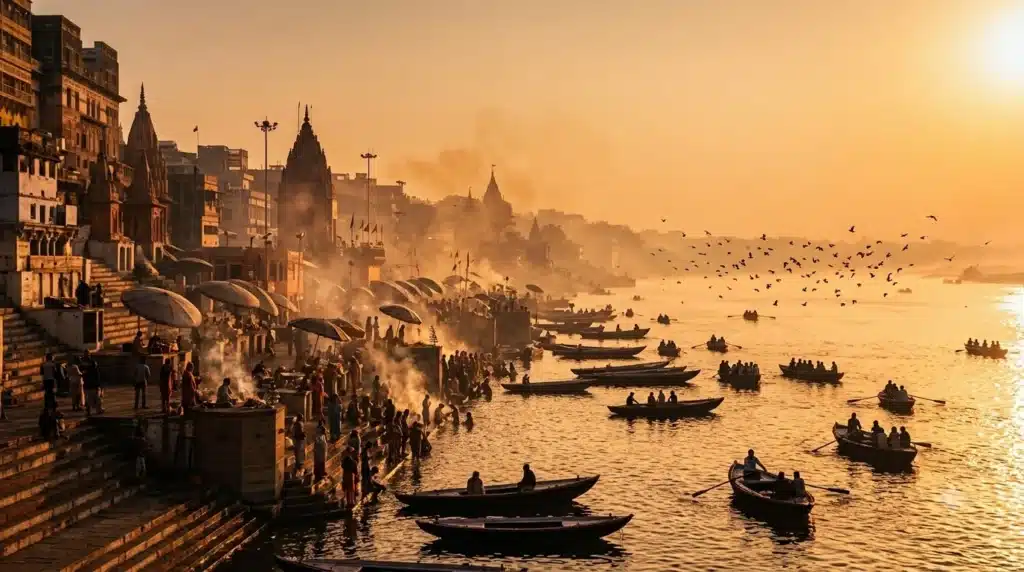
The first thing that hits you is the sound. Bells, horns, chanting, a hawker selling marigolds, a cow that has decided your path is its path.
Then the smell: woodsmoke, incense, frying dough, river. India does not ease you in. It hands you everything at once and waits to see what you do.
This Buddhist circuit spiritual trail guide follows one of the most meaningful routes in Asia. You start in Varanasi, where Hindus come to die well. You move to Bodhgaya, where Siddhartha Gautama became the Buddha. You finish in Lumbini, Nepal, where he was born.
It is a loop through three towns, two countries, and one border crossing. Done in the right order, it also takes you from loud to quiet.
By the end of this guide you will know what each stop feels like and how to behave at each one. You will also have a working Varanasi Bodhgaya Lumbini itinerary, the visa and border facts that trip people up, and a short survival kit for staying healthy and scam-free.
Varanasi: The Crucible of Life and Death
Why It Matters
Varanasi is among the oldest continuously inhabited cities on Earth. For Hindus, dying here and being cremated beside the Ganges breaks the cycle of rebirth.
That belief shapes everything you see. Elderly pilgrims arrive to spend their last weeks here. Families carry bodies through the lanes on bamboo stretchers, chanting Ram naam satya hai.
What to See
Get on the water at sunrise. A rowboat from Assi Ghat drifts north past dozens of ghats as the light turns the stone gold, and you will see people bathing, praying, doing laundry, and doing yoga, all within a few metres of each other.
In the evening, watch the Ganga Aarti at Dashashwamedh Ghat. Arrive an hour early, or book a boat and watch from the river, where you get space and a clear view.
Walk the old lanes on foot with no fixed plan. Then take a short ride to Sarnath, about 10 km away, where the Buddha gave his first sermon. It is a calm, green counterweight to the city.
Etiquette and Vibe Check
This section is your foreigners guide to Varanasi in one line: expect intensity, and don’t take it personally.
You will see cremations at Manikarnika and Harishchandra Ghats. Watch from a distance, stay quiet, and never photograph the pyres or mourners. Families will notice.
Some people find the city overwhelming on day one, and that is normal. Plan a slow first afternoon, eat something simple, and let your senses calibrate.
Bodhgaya: The Seat of Enlightenment
Why It Matters
Under a pipal tree here, roughly 2,500 years ago, the Buddha sat until he awoke. The Mahabodhi Temple now stands on that spot, and it is a UNESCO World Heritage Site.
The tree you see is a descendant of the original. Pilgrims from Sri Lanka, Thailand, Tibet, Japan, and Vietnam circle it daily.
What to See
Visit the Mahabodhi complex early, when monks are chanting and the crowds are thin. Walk clockwise around the main temple, then sit near the Bodhi Tree for as long as you like.
Many of the world’s Buddhist nations have built their own monasteries here. The Thai temple, the Japanese temple with its huge Buddha statue, and the Tibetan monasteries are all within easy reach by auto-rickshaw or bicycle.
If you want to learn rather than just look, several centres run short meditation courses for visitors. Between November and February, Tibetan teachings and prayer gatherings fill the town.
Etiquette and Vibe Check
Remove your shoes before the temple compound and dress modestly, with shoulders and knees covered. Cameras and phones may carry a small entry fee, and photography is restricted at certain points inside.
After Varanasi, Bodhgaya feels like exhaling. Still, expect touts near the gate selling “blessed” items and offering guide services. A calm “no, thank you” is enough.
Lumbini: The Birthplace in Nepal
Why It Matters
Queen Mayadevi gave birth to Siddhartha here, in a grove near what is now the Nepal–India border. Emperor Ashoka visited in the third century BCE and raised a stone pillar to mark the place. It still stands.
Lumbini is a UNESCO World Heritage Site, and it feels different from the other two stops. It is open, flat, and spacious.
What to See
Start at the Mayadevi Temple, built over the excavated remains of earlier shrines. Inside is the marker stone identifying the traditional birth spot. Next to it sits the Puskarini pond, where Mayadevi is said to have bathed.
Then spend half a day in the monastic zone, which is split into two sides. The eastern side holds Theravada monasteries, and the western side holds Mahayana and Vajrayana ones. Many were built by foreign governments and communities, so the architecture runs from Thai gold to German minimalism.
Rent a bicycle, or take a rickshaw along the canal. The distances are real, and the walking is easy.
Etiquette and Vibe Check
Silence is the rule around the Mayadevi Temple, and photography is not allowed at the marker stone. Dress as you would in Bodhgaya, and follow staff directions on queues.
Lumbini is quiet after dark, with few restaurants and little nightlife. That is the point, so bring a book.
The Cross-Border Route and Logistics Matrix
Here is a practical Varanasi Bodhgaya Lumbini itinerary. It runs west to east to north: Varanasi first for the shock, Bodhgaya for the settling, Lumbini for the stillness. Allow 8 to 10 days in total.
| Segment | Best Mode of Transport | Approx. Travel Time | Crucial Border/Visa Tip |
| Varanasi → Bodhgaya | Train to Gaya Junction, then taxi (about 15 km) | 4–5 hrs by train; 5–6 hrs by road | None. Domestic leg, carry passport copy. |
| Bodhgaya → Gorakhpur | Train from Gaya (overnight options) | 8–10 hrs | Book early. Gorakhpur is your Nepal gateway. |
| Gorakhpur → Sonauli border | Taxi or bus | About 3 hrs | Sonauli is the crossing for Lumbini. Raxaul is for Kathmandu. |
| Sonauli → Bhairahawa (Nepal) | Walk or rickshaw across | 15–30 mins | Get an India exit stamp, then a Nepal entry stamp. |
| Bhairahawa → Lumbini | Taxi or local bus | About 40 mins (22 km) | Fix a price before you get in. |
| Lumbini → onward | Flight from Bhairahawa airport, or road to Kathmandu or back to Gorakhpur | Varies | Check your India visa allows re-entry by land. |
Two border tips matter more than the rest. Carry cash in US dollars for Nepal’s visa fee, because card machines at border posts are unreliable. Cross in daylight, since transport thins out after dark.
A Foreigner’s Spiritual Survival Kit
Dress for respect, not for the weather. Cover your shoulders and knees at every temple and ghat. Lightweight cotton trousers and a long-sleeved shirt do the job and keep the sun off. Carry a scarf, which doubles as a head covering or a dust mask.
Ask before you photograph. Never shoot cremations in Varanasi, and don’t photograph monks or pilgrims in prayer without permission. Check signs at every shrine, because some bans are strict. A smile and a gesture toward your camera usually settles the question.
Handle guides and touts with calm. Fix the price before any boat ride, rickshaw trip, or guided tour. Ignore people who say a ghat or temple is “closed today, come with me instead.” Book through your hotel or a registered agency if you want fewer surprises.
Eat and drink carefully. Drink only sealed or filtered water, and avoid ice unless the place is reputable. Choose busy restaurants where food is cooked fresh and served hot. Carry hand sanitiser and oral rehydration salts, and give street food a miss for the first few days while your stomach adjusts.
Plan Your Next Sacred Journey with Samisha Holidays
Walking the Buddhist circuit rarely ends at Lumbini. If this trail has stirred something, our custom spiritual India tours can stretch your route to match: add a sunrise yoga week in Rishikesh, a Leh Ladakh tour package from Pune through high-altitude monasteries like Hemis and Thiksey, or the flower-strewn trek to Hemkund Sahib in our Valley of Flowers package. Following the Buddha’s footsteps beyond India? Our Sri Lanka tour packages from Pune lead you to Kandy’s Temple of the Tooth and the ancient Anuradhapura Bodhi Tree, a living cutting from the Bodhgaya original. For a gentler pace, our Bali tour package from Pune pairs temple ceremonies with rice-terrace quiet, and our Kerala tour package from Pune and Rajasthan package from Pune trade pilgrimage intensity for backwaters and palaces. Every Samisha itinerary includes on-call tour managers, all-inclusive pricing, and the flexibility to build group or private departures. Talk to our travel experts and turn this guide into your own tailor-made trail.
FAQs
How do I visit Lumbini from Bodhgaya?
Take a train from Gaya Junction to Gorakhpur, which takes roughly 8 to 10 hours. From Gorakhpur, travel about 3 hours by taxi or bus to the Sonauli border. Cross into Nepal, then ride 22 km from Bhairahawa to Lumbini.
What are the visa rules for crossing from India to Nepal in 2026?
Most foreign nationals need a valid India visa to exit and a Nepal visa to enter, and the Nepal visa can usually be obtained on arrival at Sonauli. Indian e-visas are generally valid for entry only at designated airports and seaports, so check whether you can re-enter India by land. Rules change often, so confirm on the official Indian and Nepali immigration websites before you book.
What is the best time to travel the Buddhist circuit?
October to March is the most comfortable window, with cool days and clear skies. April to June gets very hot, and July to September brings monsoon rain and travel delays. Buddha Purnima, usually in May, draws large crowds to all three sites.
How do I book trains in India as a foreigner?
Register on the IRCTC website or app with your passport details, or use the foreign tourist quota at major stations. Foreign travellers can book up to a year ahead, and popular routes fill fast. Choose AC classes for overnight journeys, and keep a printed ticket and passport copy handy.