
There are journeys that change your photographs. And then there are journeys that change something quieter — your pace, your perspective, the way you listen.
A combined India Nepal spiritual tour does the second thing. Consistently. Without exception.
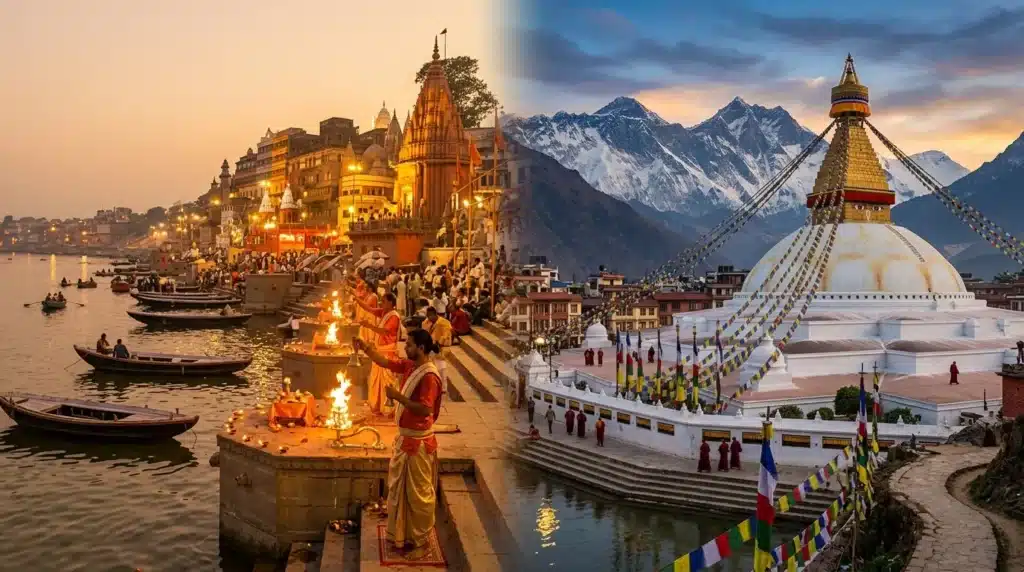
Northern India carries the weight of five thousand years of civilisation in every stone it has left standing. The Taj Mahal at dawn. Jaipur’s amber-lit forts. The Ganges at Varanasi, where ancient ritual has continued without interruption since before recorded history began. Cross the border into Nepal, and the register shifts completely — Buddhist stupas wrapped in prayer flags, Himalayan peaks rising above monastery rooftops, a quietness that arrives in the chest rather than just the ears.
Two of the world’s greatest spiritual heartlands. Fourteen days. One seamless journey.
The friction points that stop most international travellers from attempting this independently are real — coordinating cross-border flights between Varanasi and Kathmandu, managing two separate visa systems, navigating sacred sites safely without local knowledge, and finding accommodation that actually delivers on its promises rather than just its photographs.
Samisha Holidays removes every one of those friction points. As a Destination Management Company operating across India and Nepal, we handle all cross-border logistics, private luxury ground transfers, handpicked heritage hotel bookings, and dedicated English-speaking guides from arrival to departure. You carry the curiosity. We carry everything else.
The 14-Day India Nepal Spiritual Tour — Master Matrix
| Timeline | Destinations | Core Spiritual Highlight | Samisha Holidays Logistics |
| Days 1–3 | Delhi & Agra | Taj Mahal sunrise, Old Delhi heritage walk | Airport VIP transfer, private AC car, heritage hotel |
| Days 4–5 | Jaipur | Amber Fort, City Palace, royal history | Luxury ground transfer, fast-track monument access |
| Days 6–7 | Varanasi | Ganga Aarti, private Ganges boat, priestly blessing | Internal flight, riverside boutique hotel, private boat |
| Days 8–10 | Kathmandu | Boudhanath Stupa, Pashupatinath, Bhaktapur | Cross-border flight, Nepal visa coordination, local guide |
| Days 11–13 | Pokhara | Sarangkot sunrise, Phewa Lake, Annapurna views | Mountain flight or highway transfer, lakeside resort |
| Day 14 | Delhi (Departure) | Final transit and international departure | Private transfer, flight reconfirmation support |
The Full 14-Day Itinerary — Day by Day
Days 1–3: The Golden Triangle Foundation — Delhi and Agra
Delhi doesn’t introduce itself gently. It arrives in full force — the smell of street food, the weight of Mughal architecture, the sound of a city that has been continuously inhabited for over three thousand years.
Day 1 belongs to Old Delhi. Chandni Chowk at breakfast — jalebi and chai from a halwai whose family has occupied the same corner for four generations. Jama Masjid’s vast sandstone courtyard. A cycle rickshaw through the spice market lanes of Khari Baoli where sacks of cardamom, turmeric, and dried rose petals line both sides of a street barely wide enough for two people to pass.
Day 2 moves to New Delhi’s imperial register — Humayun’s Tomb, the sweeping geometry of Rajpath, the Qutub Minar complex at the southern edge of the city. Samisha Holidays assigns private licensed guides at every monument who decode history rather than simply recite dates.
Day 3 is the Agra drive — three hours by private luxury car through the flat agricultural plains of Uttar Pradesh, arriving in Agra by late afternoon. Check in, rest, and set an alarm for 5:30 am.
The Taj Mahal at sunrise is non-negotiable on Day 3 morning. Every description falls short. Stand at the central fountain axis as the marble shifts from silver to rose to blinding white and accept that some things simply have to be experienced rather than described.
Days 4–5: Royal Heritage — Jaipur
The drive from Agra to Jaipur — three hours across Rajasthan — completes the Golden Triangle with Varanasi and Nepal itinerary’s Indian foundation.
Jaipur opens with Amber Fort on the city’s northeastern ridge. A jeep ride to the entrance, then two hours inside layered Mughal-Rajput defensive architecture culminating in the Sheesh Mahal — a hall of mirrors whose thousands of inlaid reflections multiply a single candle flame into an entire constellation.
City Palace fills the afternoon — the royal residence that remains partially occupied by the Jaipur royal family, its courtyards carrying the specific dignity of spaces that have never stopped being used.
Day 5 covers Jantar Mantar — the 18th-century astronomical observatory that most visitors spend twelve minutes examining when it deserves ninety — and Jaipur’s famous bazaars. Block-printed textiles, blue pottery, and the particular chaos of Johari Bazaar’s jewellery lane fill the morning before the afternoon flight to Varanasi.
Days 6–7: The Mystic Ghats — Varanasi
Nothing in the preceding five days quite prepares travellers for Varanasi. This is India at its most ancient, most confronting, and most deeply alive.
The city exists in a different relationship with time. Ghats descend to the Ganges at intervals — each one with its own history, its own community of priests, boatmen, and pilgrims. The river at dawn carries flower offerings, ash from the cremation ghats at Manikarnika, and the particular quality of light that photographers return to Varanasi specifically to chase.
The Ganga Aarti ceremony at Dashashwamedh Ghat happens every evening at sunset — brass lamps moving in synchronised arcs, chanting priests, incense clouds, and thousands of devotees pressed together on the steps. It is extraordinary even in a crowd.
Samisha Holidays arranges a privately chartered wooden river boat positioned mid-stream, away from the crowded bank, with unobstructed views of the entire ceremony across the water. A live classical sitar performance accompanies the visual spectacle. This is the Varanasi experience that stays for years.
Day 7 morning includes a pre-dawn Ganges boat ride through the quietest hour — the river before the city wakes, oil lamps still floating from the previous evening’s offerings, mist on the water’s surface, the occasional sound of distant temple bells.
Days 8–10: The Sacred Valley of Kathmandu — Nepal Transition
The flight from Varanasi to Kathmandu takes under an hour. Samisha Holidays coordinates every documentation detail for this transition — immigration briefing, Nepal visa coordination, and Kathmandu hotel check-in managed before you’ve left your Varanasi hotel.
Boudhanath Stupa anchors Day 8. Among the largest Buddhist stupas in the world, its painted eyes watch over a perimeter of Tibetan monasteries, butter-lamp-lit prayer halls, and rooftop cafes where monks and travellers sit side by side. Walking the kora — the circumambulation path around the stupa base — with prayer beads and other devotees in the early morning is a meditative experience available to anyone willing to arrive before 7 am.
Pashupatinath Temple on the Bagmati River is Hinduism’s most sacred site in Nepal. The riverside ghats here carry a quieter version of the Varanasi atmosphere — cremations, priests, pilgrims, and the specific solemnity of a place that exists entirely outside ordinary time.
Day 9 belongs to Bhaktapur Durbar Square — a medieval city-state’s royal plaza largely unchanged since the 15th century. Wood-carved temples rise from stone-paved courtyards where pottery artisans work in the same techniques their ancestors used. Samisha Holidays arranges a specialist architectural guide for Bhaktapur who understands the iconography of every carved deity and structural detail.
Day 10 provides breathing room in Kathmandu — the Thamel quarter for shopping, a cooking class in a traditional Newari home, or an afternoon at a monastery meditation session arranged through our local monastic contacts.
Days 11–13: Himalayan Peace — Pokhara
The Kathmandu to Pokhara mountain flight takes 25 minutes and runs along the Annapurna range at close enough range that individual ridgelines are distinguishable from the cabin window. Dhaulagiri. Manaslu. Machhapuchhre — the fishtail peak that no human has ever been permitted to summit.
Alternatively, the highway journey takes approximately 6 hours through river valleys and mid-hill landscapes — a valid choice for travellers who want to see Nepal’s agricultural interior rather than its aerial topography.
Sarangkot at dawn is the Pokhara experience most travellers carry home as their defining Nepal memory. The viewpoint above the city reveals the full Annapurna Himalayan chain in a single unbroken panorama at sunrise — peaks catching the first light while the Pokhara valley below remains in shadow.
Phewa Lake fills the morning — a wooden rowboat on still water reflecting the Annapurna range, the World Peace Pagoda visible on the ridge above the far shore. This is the most genuinely peaceful moment in the entire 14-day itinerary. No commentary needed.
Day 13 at leisure in Pokhara — the lakeside street’s excellent coffee shops, Tibetan craft markets, or a guided trek into the surrounding foothills for travellers with remaining energy.
Day 14: Return to Delhi and Departure
The return routing from Pokhara to Delhi connects through Kathmandu — Samisha Holidays coordinates both flight legs and manages the Kathmandu transit timing to ensure comfortable international connections.
Arrival at Delhi’s Indira Gandhi International Airport. Our team meets you at the domestic arrival hall and transfers directly to the international terminal — with sufficient time built in for check-in, duty-free, and the particular mixed feeling of a journey that’s ending too soon.
Local Insider Rituals — Exclusive Experiences Managed by Samisha Holidays
Private Priestly Blessings in Varanasi
Varanasi’s most respected lineage priests — families whose ancestors have performed Ganges rituals for generations — are not accessible through general tourist channels. Samisha Holidays maintains relationships with specific priestly families who offer private blessing ceremonies for international guests. These are conducted at the riverside before the main crowds arrive, in a genuine religious context rather than a staged performance.
Meditation and Monk Interactions in Kathmandu
Several Tibetan Buddhist monasteries in the Boudhanath area admit small groups for early morning puja — the daily prayer ceremony conducted by resident monks. Samisha Holidays arranges access and assigns a cultural interpreter who explains the significance of each element of the ritual. Sitting inside a monastery in the pre-dawn quiet while monks chant and butter lamps flicker is the kind of experience that resets something fundamental.
Fast-Track Monument Access Throughout
India’s most visited monuments — the Taj Mahal, Amber Fort, Pashupatinath — have standard queuing systems that can consume 45 minutes to over an hour during peak periods. Samisha Holidays uses pre-purchased priority access, dedicated guide lanes, and optimal arrival timing to eliminate queue time at every major site throughout the 14-day itinerary.
Expand Your Subcontinent Experience — Our Signature Regional Packages
This 14-day India Nepal journey is one configuration within a much broader South Asian portfolio. For travellers wanting to extend further, our Ultimate South Asia Panorama: 21-Day Itinerary adds Bhutan and Sri Lanka to the arc for the complete four-country experience. The full logistics of combining India, Nepal, and Bhutan are covered in our How to Plan a Seamless Multi-Country Tour to India, Nepal, and Bhutan — essential reading before planning any cross-border Himalayan journey. Travellers curious about Bhutan’s visa and fee structure should start with our Bhutan Travel Guide for Foreigners: SDF and Visas Explained — the most comprehensive English-language resource on Bhutan’s entry requirements available online. For guests wanting to deepen their India experience beyond the spiritual circuit, Beyond the Taj Mahal: 10 Culturally Immersive Luxury Experiences covers private palace access, leopard safaris, and sacred fire dance ceremonies. And first-time India visitors navigating entry documentation should read our Traveling to India from USA/UK: A Complete Guide before booking any element of this itinerary.
Book Your India Nepal Spiritual Journey With Samisha Holidays
A combined India and Nepal tour is, for most travellers who complete it, the journey they measure every subsequent trip against.
The spiritual depth available across these two countries — from Varanasi’s river rituals to Kathmandu’s monastery courtyards to the Annapurna range at sunrise above Pokhara — accumulates across 14 days into something that functions less like a holiday and more like a genuine shift in perspective.
Booking directly with a local regional expert rather than a Western aggregator means every logistical detail is managed by people who know these destinations from years of on-ground experience — not from research documents. The private transfers run on time. The guides are genuine specialists. The accommodation delivers what it promises.
Fill out our customised international inquiry form today to schedule a complimentary itinerary consultation with a senior travel architect at Samisha Holidays. We’ll map your exact routing, accommodation preferences, and special interests into a personalised 14-day blueprint — with transparent pricing and a clear logistics timeline.
The Ganges is waiting. So are the Himalayas.
Frequently Asked Questions
Q1. Do US and UK citizens need separate visas for India and Nepal on this tour?
Yes — India and Nepal operate entirely separate visa systems. India requires an e-Tourist Visa applied for online before departure, typically processed within 72 to 96 hours through the official Indian government portal. Nepal offers visa on arrival at Kathmandu’s Tribhuvan International Airport for both US and UK citizens — the fee is payable in USD cash at the immigration counter. Samisha Holidays provides complete pre-departure documentation guidance for both visa processes and ensures every guest has the correct paperwork well before their departure date.
Q2. What is the best time of year to do this 14-day India Nepal spiritual tour?
October through March is the optimal window for this combined itinerary. Post-monsoon clarity through November and December delivers excellent Himalayan visibility for the Pokhara Annapurna views and the Kathmandu to Pokhara mountain flight. Temperatures across Northern India are comfortable for sightseeing between October and February. Spring (March to April) is equally beautiful — the rhododendron forests around Pokhara bloom and Varanasi’s morning light is extraordinary in March. Samisha Holidays recommends avoiding June through September for this specific routing due to monsoon conditions affecting both Northern India road travel and Himalayan visibility.
Q3. How does the cross-border flight from India to Nepal work on this itinerary?
The most efficient routing is a direct flight from Varanasi (VNS) to Kathmandu (KTM) — approximately 1 hour — which Samisha Holidays books and confirms as part of the complete package. Alternatively, the Delhi to Kathmandu routing works well for travellers whose Jaipur to Varanasi scheduling doesn’t align with direct Varanasi-Kathmandu flight availability. All internal and cross-border flights within this itinerary are coordinated by Samisha Holidays as a single unified booking, including baggage transfer management between carriers.
Q4. Is this itinerary suitable for senior travellers or those with limited mobility?
Yes — with appropriate customisation. The core itinerary is designed around private vehicles, which means pace is entirely controlled by the group. Monument visits can be shortened or extended as needed. The Pokhara Sarangkot sunrise viewpoint requires a vehicle drive and short walk — manageable for most senior travellers. The Varanasi ghat steps present the most significant mobility challenge — Samisha Holidays arranges boat access from flat entry points that bypass the main stepped ghats entirely for guests who need this alternative. Share specific mobility requirements at the inquiry stage, and we customise accordingly.
Q5. What accommodation standard does Samisha Holidays use across this 14-day itinerary?
Our standard booking across this itinerary uses 4-star and 5-star heritage properties — palace conversions in Jaipur, boutique riverside hotels in Varanasi, and lakeside resorts in Pokhara that balance genuine comfort with local character. In Delhi and Agra, we select properties in central heritage zones rather than peripheral business hotel districts. Accommodation can be upgraded to ultra-luxury — including palace hotels and private villa configurations — or adjusted to premium 3-star for guests managing tighter budgets. Every property we use has been personally vetted by our team rather than selected from an online aggregator database.