
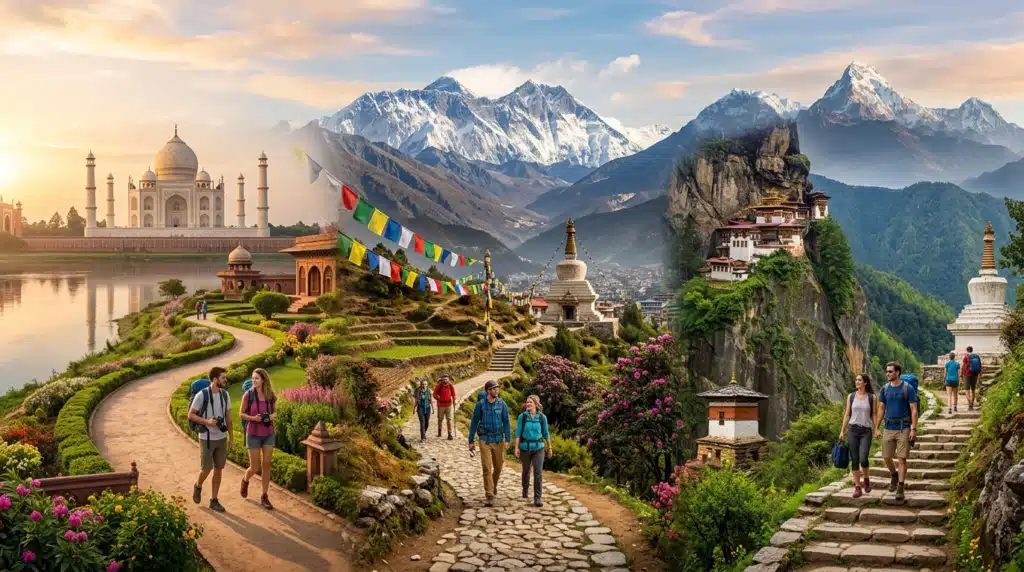
Three countries. One unforgettable arc. The royal grandeur of India, the spiritual peaks of Nepal, and the untouched fortress valleys of Bhutan — together, they form the single most rewarding cultural journey available anywhere on earth.
But here’s where the dream usually collides with reality. Three separate visa systems. Limited Drukair and Bhutan Airlines flight schedules that fill months in advance. Three different currencies. Border permit restrictions that change without warning.
Most travellers who attempt to plan this independently lose weeks to logistics before they’ve booked a single hotel.
Samisha Holidays exists specifically to remove that friction. As a regional Destination Management Company operating across India, Nepal, and Bhutan, we coordinate every visa, every flight, every cross-border transfer, and every permit under one unified booking. You focus on the journey. We handle everything that makes it possible.
This guide explains exactly how a flawless India Nepal Bhutan tour package comes together — and why the logistics, properly managed, become invisible.
The Triple-Nation Master Logistics Matrix
| Country | Visa/Permit for US/UK Citizens | Primary Airport | Must-See Highlight | Currency Tip |
| India | e-Tourist Visa (apply online, 72–96 hrs) | Delhi (DEL) | Taj Mahal, Agra | Carry INR cash; UPI widely used |
| Nepal | Visa on arrival at Kathmandu | Kathmandu (KTM | Boudhanath Stupa | Nepalese Rupee; USD accepted in tourist areas |
| Bhutan | TCB permit + SDF (mandatory licensed operator) | Paro (PBH) | Tiger’s Nest Monastery | Ngultrum pegged to INR; carry cash in rural areas |
The Perfect Blueprint — A Seamless Multi-Country Itinerary Skeleton
Leg 1: The Cultural Core — India (7 to 8 Days)
India opens the journey with its full sensory force. Delhi for two to three days — Old Delhi’s chaos, Humayun’s Tomb, the Red Fort’s imperial scale.
Agra follows. The Taj Mahal at sunrise remains the single image most travellers carry home from this entire three-country journey. Fatehpur Sikri adds historical depth for those with extra time.
Varanasi closes the India leg deliberately. This isn’t incidental routing — it’s strategic. Varanasi sits geographically positioned for a short, direct flight connection into Kathmandu, making it the natural launching pad into Nepal rather than backtracking through Delhi.
Watching the Ganga Aarti ceremony at Dashashwamedh Ghat, then boarding a flight the following morning toward the Himalayas, creates a narrative arc few itineraries achieve — ancient riverside spirituality giving way directly to mountain spirituality within 24 hours.
Leg 2: The Spiritual Peak — Nepal (4 to 5 Days)
The flight from Varanasi to Kathmandu takes under an hour, and Samisha Holidays manages every document required for that transition before you’ve even checked out of your Varanasi hotel.
Kathmandu reveals itself through its sacred geography. Boudhanath Stupa — among the largest in the world — anchors the city’s Tibetan Buddhist heart, painted eyes watching over a perimeter of monasteries and butter-lamp-lit prayer halls. Pashupatinath Temple, Bhaktapur Durbar Square, and Swayambhunath round out Kathmandu’s layered cultural depth.
Pokhara follows — a 25-minute mountain flight along the Annapurna range, with Dhaulagiri and Machhapuchhre visible at eye level through the cabin window. Phewa Lake at dawn, the Annapurna range reflected perfectly in still water, is Nepal’s quiet masterpiece moment.
Leg 3: The Last Shangri-La — Bhutan (5 to 6 Days)
The flight from Kathmandu to Paro is, by any honest measure, one of the most extraordinary scheduled flights in commercial aviation. On clear mornings, Everest, Kangchenjunga, and the full Himalayan spine are visible from the cabin before the aircraft descends into Paro’s narrow mountain valley.
Understanding Bhutan’s Entry Requirements
Bhutan operates differently from India and Nepal. The Sustainable Development Fee (SDF) applies to all international visitors, funding the country’s free healthcare and education systems. Critically, booking through a licensed local travel agent for Bhutan and Nepal is not optional — it’s legally mandatory for international tourists. Independent, unguided travel within Bhutan simply isn’t permitted.
Samisha Holidays holds the necessary Tourism Council of Bhutan accreditation and manages the entire SDF payment and permit process as a standard part of every itinerary.
Thimphu opens the Bhutan leg — Buddha Dordenma overlooking the valley, Tashichho Dzong’s whitewashed fortress architecture. Punakha follows via the spectacular Dochula Pass, where 108 memorial chortens frame uninterrupted Himalayan views. Punakha Dzong itself, built at the confluence of two rivers in 1637, is widely regarded as Bhutan’s most beautiful structure.
Paro and the Tiger’s Nest hike close the journey. Taktsang Monastery clings to a cliff face 900 metres above the valley floor — a two-hour climb through blue pine forest that delivers, without exaggeration, one of the most visually overwhelming moments available to any traveller on earth.
Behind the Scenes — How Samisha Holidays Ensures Flawless Synchronization
Multi-Destination Flight Coordination
Regional carriers across India, Nepal, and Bhutan operate with varying baggage allowances, check-in protocols, and schedule reliability. Drukair and Bhutan Airlines, in particular, run limited weekly frequencies into Paro — seats sell out months ahead during peak season.
Samisha Holidays books and confirms all internal and cross-border flights as a single coordinated booking. Baggage allowances are tracked and communicated to guests in advance, preventing the excess-fee surprises that catch independent travellers off guard at regional check-in counters.
Private Transfers and Local Expertise
Every leg of this journey includes a private, English-speaking local guide and driver — not a shared coach, not a rotating cast of unfamiliar faces. Border customs checkpoints between Nepal and Bhutan’s flight transition, and India’s domestic-to-international terminal shifts, are handled by our on-ground teams who manage these crossings routinely.
Consequently, guests experience zero friction at moments that typically cause the most stress in independent multi-country planning.
Handpicked Accommodation Reflecting True National Character
Hotel selection across this itinerary isn’t generic. India’s properties lean into heritage havelis and royal palace conversions. Nepal’s selections balance Kathmandu’s boutique character with Pokhara’s lakeside serenity. Bhutan’s properties — many built in traditional rammed-earth architecture — reflect the kingdom’s deliberate, unhurried aesthetic.
Each property is personally vetted by our travel designers. Alternatively, for guests with specific preferences — adults-only properties, accessibility requirements, extended family configurations — Samisha Holidays customises the accommodation matrix entirely around individual needs.
Tailor Your Himalayan and Subcontinent Journey
This three-country blueprint is just one configuration within a broader portfolio of South Asia experiences. For travellers wanting the complete four-country arc, our Ultimate South Asia Panorama: 21-Day Itinerary extends this journey into Sri Lanka’s tropical coastline. First-time visitors to India navigating entry logistics should start with our Traveling to India from USA/UK: A Complete Guide, covering e-Visa rules and arrival protocols in full detail. Travellers focused purely on India’s royal heartland will find our Luxury Golden Triangle and Cross-Border Asia Tours ideal for shorter, intensive itineraries. And for guests seeking a fully bespoke regional experience beyond any fixed template, our Private Luxury Tours of South Asia are designed entirely around your dates, interests, and pace.
Book Your India Nepal Bhutan Journey With Samisha Holidays
A multi-country South Asia tour is, for most travellers, a once-in-a-lifetime undertaking. It shouldn’t be spent anxiously refreshing visa portals, second-guessing regional flight connections, or discovering a missed Bhutan permit deadline three weeks before departure.
Paradoxically, the journeys that feel most effortless are always the ones with the most sophisticated planning happening invisibly behind them. That’s precisely what a dedicated regional DMC delivers — and what independent planning, however diligent, simply cannot replicate across three distinct national systems.
Fill out our bespoke international inquiry form today and schedule a private call with a Samisha Holidays regional travel designer. Together, you’ll map out your custom India, Nepal, and Bhutan blueprint — exact routing, accommodation selections, transparent pricing, and a permit timeline that keeps every border crossing seamless.
The last Shangri-La is waiting. Let’s get you there properly.
Frequently Asked Questions
Q1. Can US and UK citizens get visas for India, Nepal, and Bhutan easily?
Yes — though each country follows a different process. India requires an e-Tourist Visa applied for online before departure, typically processed within 72 to 96 hours. Nepal offers visa on arrival at Kathmandu’s Tribhuvan International Airport for both US and UK citizens. Bhutan requires a Tourism Council of Bhutan permit along with the Sustainable Development Fee, which must be arranged through a licensed local operator — independent applications aren’t accepted. Samisha Holidays manages all three processes as a single coordinated package, so guests never have to navigate three separate government systems on their own.
Q2. How many days are needed for a complete India Nepal Bhutan tour?
A well-paced multi-country itinerary needs a minimum of 16 to 19 days — 7 to 8 days in India covering Delhi, Agra, and Varanasi, 4 to 5 days in Nepal covering Kathmandu and Pokhara, and 5 to 6 days in Bhutan covering Thimphu, Punakha, and Paro. Shorter trips are possible by trimming a destination, but Samisha Holidays generally advises against compressing Bhutan below 4 days, since the Tiger’s Nest hike alone requires a full unhurried day to do properly.
Q3. Is the Kathmandu to Paro flight safe, and what makes it special?
Yes — the Kathmandu to Paro route is operated by experienced Bhutanese pilots specifically trained for Himalayan mountain flying, and it’s considered one of the safest scheduled routes in the region despite its dramatic terrain. On clear days, passengers get window views of Everest, Kangchenjunga, and the full Himalayan range before the aircraft descends into Paro’s narrow valley approach. Flights operate on limited weekly schedules through Drukair and Bhutan Airlines, so Samisha Holidays recommends booking this leg as early as possible, particularly during peak autumn and spring travel seasons.
Q4. Why can’t I book Bhutan independently like India or Nepal?
Bhutan’s tourism policy requires all international visitors to book through a licensed Bhutanese tour operator or an accredited partner DMC — unguided independent travel within the country isn’t permitted under current regulations. This system funds the Sustainable Development Fee model that supports Bhutan’s free healthcare and education infrastructure, and it also ensures every visitor travels with a licensed guide throughout their stay. Samisha Holidays holds the necessary Tourism Council of Bhutan accreditation, meaning the entire booking, permit, and SDF payment process happens as one seamless step within your overall India Nepal Bhutan itinerary.
Q5. What is the best time of year to do this three-country tour?
Spring (March to May) and autumn (September to November) are the ideal windows for this combined journey. Both seasons offer clear Himalayan visibility for the Kathmandu to Paro flight, comfortable temperatures across all three countries, and the best conditions for outdoor experiences like the Tiger’s Nest hike and Pokhara’s lake views. Autumn additionally aligns with several Bhutanese and Nepali festivals, adding genuine cultural depth to the trip. Samisha Holidays recommends booking flights and Bhutan permits at least 8 to 10 weeks in advance for either season, since regional flight seats are limited and fill quickly.