
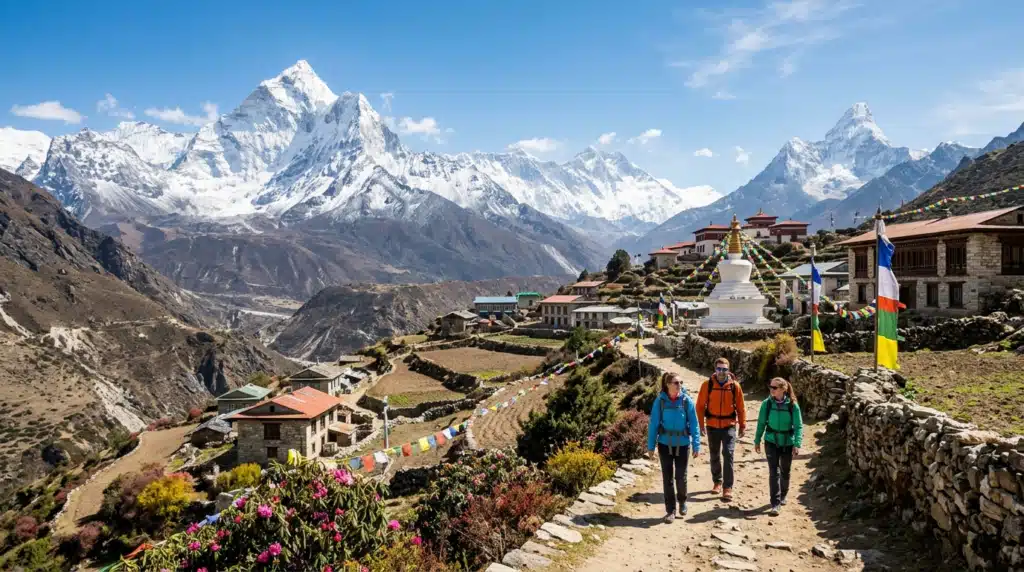
The first time you see the Himalayas — really see them, not in a photograph but standing in front of them at dawn — something shifts that doesn’t shift back.
Nepal holds eight of the world’s ten highest peaks. It holds ancient Buddhist stupas that have been circumambulated by devotees for two thousand years. It holds medieval city squares that look substantially unchanged from the 15th century. And it holds trekking trails that beginners complete successfully every single season — with the right preparation and the right team alongside them.
The fears that stop most first-time visitors from booking are understandable. Acute mountain sickness. Physical fitness requirements. Uncertainty about whether teahouse infrastructure is adequate. Trail navigation in unfamiliar terrain. These are legitimate concerns — and every one of them has a straightforward answer when you’re working with people who know the mountains properly.
Samisha Holidays operates across Nepal as a regional Destination Management Company — private English-speaking guides, certified porters with fair employment standards, helicopter backup logistics on all trekking itineraries, internal domestic flights, and handpicked boutique heritage properties in Kathmandu and Pokhara. The Himalayas without the stress. That’s what we provide.
The Beginner’s Nepal Travel Matrix
| Region / Trail | Max Altitude | Trek / Tour Type | Core Highlight | Fitness Level Required |
| Kathmandu Valley Heritage | 4,430 ft (1,350m) | Cultural city tour | Boudhanath, Bhaktapur, Swayambhunath | None — walking only |
| Ghorepani Poon Hill Trek | 10,499 ft (3,200m) | Short beginner trek | Annapurna sunrise panorama | Moderate — 4 to 6 hours walking daily |
| Everest View Luxury Lodge Trek | 11,286 ft (3,440m) | Comfort lodge trek | Everest and Lhotse views from Namche | Moderate — manageable with acclimatisation day |
| Pokhara Lakeside | 2,713 ft (827m) | Leisure base | Phewa Lake, Annapurna reflections | None — complete leisure |
Unlocking the Kathmandu Heritage Itinerary — Culture Before the Climb
Why Kathmandu Comes First
Every Nepal itinerary Samisha Holidays designs — regardless of trekking ambition — starts with two full days in Kathmandu. This isn’t incidental scheduling. It’s altitude acclimatisation and cultural grounding happening simultaneously.
Kathmandu sits at 1,350 metres — low enough that no altitude concern applies, high enough that two days here begin the gentle physiological adjustment that makes higher trails safer. Start walking the cultural circuit before the mountain circuit.
Boudhanath Stupa
Boudhanath is among the largest Buddhist stupas in the world. The mandala-shaped structure dominates its neighbourhood — prayer wheels line the entire perimeter base, Tibetan monasteries ring the outer circuit, and the painted eyes of the Buddha observe the kora (circumambulation walk) from every angle.
Arrive by 6:30 am. The morning kora — monks, elderly devotees, and the occasional pilgrim who has walked here from Tibet — is the most peaceful and most genuine thing you can do in Kathmandu. Walk three circuits clockwise, turn prayer wheels with your right hand, and observe without rush.
Bhaktapur Durbar Square
Bhaktapur is a medieval city-state’s royal plaza that the 20th century largely bypassed. Stone-paved courtyards lead between 15th-century temples where woodcarvers still work the same intricate patterns their ancestors established. The pottery square nearby has been a working production centre for centuries — the same earthenware shapes made by the same families using techniques passed down without interruption.
Samisha Holidays assigns specialist heritage guides for Bhaktapur who have studied the site’s architectural iconography formally — the difference between a guide who names temples and one who explains them is the difference between sightseeing and understanding.
Swayambhunath — The Monkey Temple
Swayambhunath sits on a hilltop above western Kathmandu — 365 steps to the summit, where a golden stupa painted with the same all-seeing Buddha eyes as Boudhanath watches over the entire valley. Long-tailed macaques inhabit the complex freely. The view from the top across the Kathmandu valley to the Himalayan rim on the northern horizon is the first genuinely orienting moment of the Nepal trip.
The Best Beginner Treks in Nepal — Panoramic Views Without the Pain
The Ghorepani Poon Hill Trek
If you could design the perfect beginner trek — short enough to complete comfortably, dramatic enough to justify the effort, scenically positioned to deliver the Himalayan panorama most people have in their minds when they think “Nepal” — you would design something very close to the Ghorepani Poon Hill Trek.
The route starts from Nayapul, approximately 90 minutes by car from Pokhara. Four days of walking through rhododendron forest, Gurung villages, and steadily ascending ridgelines bring trekkers to Poon Hill at 3,210 metres — a viewpoint that commands an unbroken 180-degree panorama of the Annapurna and Dhaulagiri mountain ranges.
The Poon Hill summit walk happens at 5 am on Day 3 — headlamps, cold air, and a trail full of other trekkers making the same pre-dawn climb. The summit fills with people well before sunrise. Then the sky turns, the peaks appear, and the crowd goes completely silent.
Annapurna I at 8,091 metres. Dhaulagiri at 8,167 metres. Hiunchuli, Gangapurna, Annapurna South — a wall of high Himalayan peaks catching the first light while the valleys below remain in shadow. No photograph captures this. The standard comparison among trekkers who’ve done both is that Poon Hill’s sunrise panorama rivals Everest Base Camp for visual impact at a fraction of the physical commitment.
Daily walking distances on this route average 4 to 6 hours — achievable for any reasonably active person without prior trekking experience. Trails are well-marked and heavily used. Samisha Holidays assigns a private guide throughout and provides certified porters who carry all luggage above 5 kilograms — trekkers carry only a day pack with water, snacks, and a camera.
The Everest View Luxury Lodge Trek
The full Everest Base Camp trek — 14 days, reaching 5,364 metres — is not a beginner proposition. It demands sustained fitness, significant altitude tolerance, and two weeks of teahouse accommodation with variable standards.
The Everest View Luxury Lodge Trek is an entirely different experience. This route flies into Lukla and ascends through Phakding to Namche Bazaar at 3,440 metres — then spends two nights at a high-altitude comfort lodge like Yeti Mountain Home or similar premium properties that have transformed the lower Khumbu experience.
From Namche, the views of Mount Everest (8,849 metres), Lhotse, and Nuptse are clear on morning walks to the Everest View Hotel point at 3,880 metres. The summit is not visible from here — only the upper pyramid above the Western Cwm — but what is visible is enough to produce the genuine stillness that Everest does to people who encounter it in person for the first time.
The return to Lukla follows the same route. Total trek duration is 6 to 7 days. The altitude at Namche is manageable with the correct acclimatisation schedule — Samisha Holidays builds a rest day into every Namche itinerary without exception.
Accommodation at premium Khumbu lodges — stone-built properties with heated dining rooms, private attached bathrooms, and menus well above standard teahouse fare — makes this route accessible for travellers who want the Everest experience without compromising on nightly comfort.
The Pokhara Transition — Lakeside Serenity and Mountain Reflections
Every Samisha Holidays Nepal itinerary builds Pokhara in as a dedicated rest base — either before the Poon Hill departure or after the return, typically both.
Phewa Lake on a calm morning reflects the Annapurna range in still water — the fishtail peak of Machhapuchhre appearing twice, once above the horizon and once below the waterline. A wooden rowboat rented for an early morning hour is the cheapest extraordinary thing available in Nepal.
The World Peace Pagoda on the ridge above the lake’s southern shore provides the reverse view — looking back over the lake toward the city, with the Himalayan backdrop behind. The walk up takes about 45 minutes through forest. The descent on the lake-facing side connects to a shoreline path back to the tourist strip.
Post-trek massage therapy is widely available along Pokhara’s lakeside street — Nepali and Tibetan massage practices at prices that make extended sessions genuinely practical. After four days of Poon Hill trail walking, two hours of professional attention is not indulgence. It’s necessary.
Mountain Safety Masterclass — Acclimatisation, Hydration, and Porter Ethics
Altitude and Acclimatisation
The foundational rule of altitude trekking: ascend slowly, descend quickly. Samisha Holidays adheres to the standard guideline of gaining no more than 300 to 500 metres of sleeping altitude per day above 3,000 metres — with a rest day built in every second day of ascent.
Acute Mountain Sickness symptoms — headache, nausea, fatigue, loss of appetite — are normal at altitude and manageable with rest and hydration. They are also the body’s signal to stop ascending until they resolve. Samisha Holidays guides are trained to recognise AMS symptoms and are authorised to halt ascent regardless of guest preference. A helicopter evacuation protocol is pre-arranged for all trekking itineraries — emergency extraction from Lukla or Namche can be organised within hours.
Hydration and Meals
Drink 3 to 4 litres of water daily while trekking — more than feels necessary, consistently throughout the day rather than in large volumes at rest stops. Samisha Holidays provides water purification tablets and bottled water at teahouse and lodge stops on all routes.
Trail meals — dal bhat, noodle soup, eggs, porridge — are nutritionally appropriate for trekking energy requirements. Our guide team inspects kitchen hygiene standards at every stop and redirects to alternative properties where standards aren’t adequate.
Porter Ethics and Fair Treatment
Every porter engaged by Samisha Holidays carries a maximum load of 20 kilograms, receives weather-appropriate clothing and equipment, holds valid trekking insurance, and receives the fair wage rates established by the Trekking Agencies’ Association of Nepal.
Tipping is genuine appreciation rather than obligation — our pre-departure briefing covers appropriate amounts and the most respectful way to handle it at trek completion. Sherpa guides and porters work exceptionally hard in physically demanding conditions. Treating that work with respect and appropriate compensation is the non-negotiable standard we apply on every departure.
Cross-Border Explorations — Connect the Himalayas With South Asia
Nepal works beautifully as a standalone destination and equally well as part of a broader South Asian journey. For travellers wanting to extend the Himalayan experience, our Ultimate South Asia Panorama: 21-Day Itinerary combines Nepal with India, Bhutan, and Sri Lanka in a single seamless arc. The complete logistics of adding Bhutan to a Nepal itinerary are detailed in our How to Plan a Seamless Multi-Country Tour to India, Nepal, and Bhutan — including Drukair flight coordination from Kathmandu to Paro. Before adding Bhutan to any itinerary, our Bhutan Travel Guide for Foreigners: SDF and Visas Explained covers every permit and fee requirement with complete transparency. And for travellers combining the Kathmandu spiritual experience with Northern India’s cultural circuit, our Perfect 14-Day Northern India and Nepal Spiritual Tour Package sequences the Ganges, the Taj Mahal, and the Annapurna range into one continuous journey.
Book Your Beginner Nepal Journey With Samisha Holidays
The Himalayas are not reserved for hardcore mountaineers. They are not exclusively for ultra-fit athletes who train for months before departure.
The Poon Hill sunrise is available to anyone who can walk 5 hours a day for four consecutive days. The Everest view from above Namche is available to anyone willing to fly to Lukla and take it one altitude band at a time. The Boudhanath morning kora is available to anyone who sets an alarm for 6 am.
What makes the difference between a stressful mountain experience and a transformative one is the team alongside you — guides who know the signs of altitude stress before symptoms worsen, porters who carry the weight so your legs carry only themselves, and logistics that anticipate the complications before they become problems.
Fill out our custom Nepal inquiry form today and receive a personalised, beginner-friendly trekking and heritage itinerary blueprint from a dedicated Samisha Holidays Nepal specialist. We’ll match the right trail to your fitness level, build the right acclimatisation schedule, and select accommodation that matches your comfort expectations — in a single consultation that takes the uncertainty out of the entire planning process.
The mountains are not going anywhere. Your first view of them, however — that happens exactly once.