
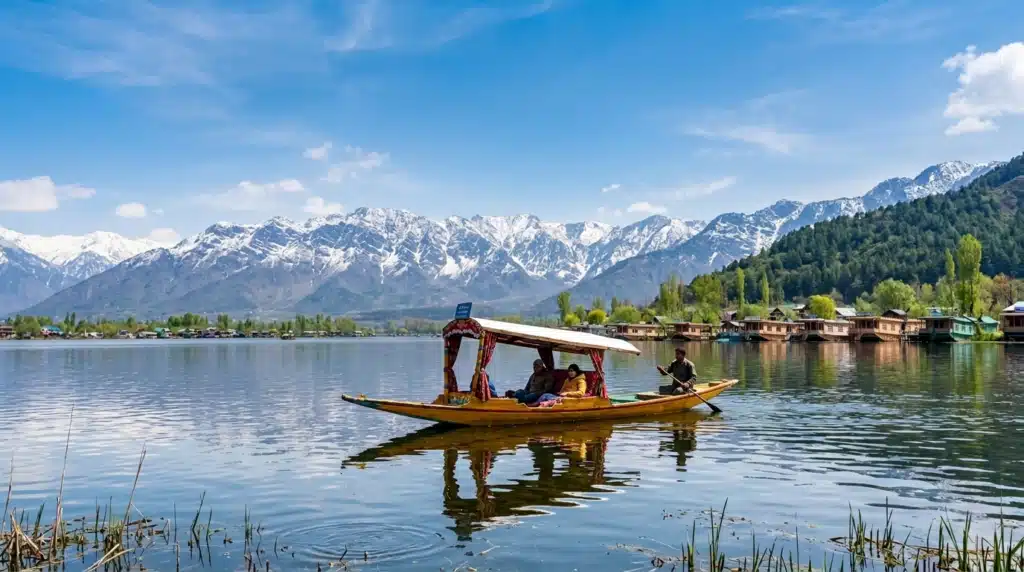
Every season in Kashmir looks like the cover of a magazine that doesn’t exist yet.
January’s frozen Dal Lake reflecting a steel-grey sky. April’s tulip garden erupting across the Zabarwan hillside in bands of red, purple, and white. September’s chinar trees turning amber and gold against the Mughal garden walls. December’s Gulmarg meadows buried under snow so deep it reaches the windows of hillside guesthouses.
The question of the best time to visit Kashmir in 2026 doesn’t have a single answer — it has four, one for each season, each delivering a completely different version of the same extraordinary valley.
This guide breaks down every month of the Kashmir travel calendar with the specificity that Pune travellers actually need — exact weather conditions, what’s happening on the ground, what to wear, and which sightseeing priorities apply to each window. At Samisha Holidays, we’ve been building Kashmir tour packages from Pune across every season for years. What follows is the planning intelligence that comes from that direct operational experience.
Kashmir Month-by-Month Weather and Sightseeing Matrix
| Month | Weather Condition | Key Highlight | Clothing Recommendation |
| January | −5 to 5°C; heavy snowfall | Frozen Dal Lake, Gulmarg skiing | Heavy wool coat, thermal underlayers, insulated boots, gloves |
| February | −3 to 8°C; snowfall continuing | Snow festivals, Gulmarg Gondola | Same as January; add waterproof outer layer |
| March | 5 to 15°C; snow melting | Early almond blossom, first tulip shoots | Medium wool layers, light waterproof jacket |
| April | 10 to 20°C; clear and bright | Tulip Festival peak, Dal Lake Shikara | Light jacket, scarf, comfortable walking shoes |
| May | 15 to 25°C; pleasantly warm | Mughal gardens in full bloom, Sonmarg open | Light cotton with a warm layer for evenings |
| June | 18 to 28°C; warm and green | Pahalgam meadows, Amarnath Yatra begins | Light cotton, sun protection, hat |
| July | 20 to 30°C; occasional rain | Sonmarg wildflowers, valley at greenest | Light layers, waterproof poncho |
| August | 18 to 28°C; moderate rain | Betaab Valley lush, Lidder River full | Light cotton, waterproof layer for showers |
| September | 12 to 22°C; crisp and clear | Chinar colour begins, apple harvest | Medium layers, light jacket for evenings |
| October | 8 to 18°C; golden autumn | Peak chinar season, Mughal gardens golden | Medium wool, warm jacket, comfortable layers |
| November | 2 to 12°C; first winter chill | Early snowfall on higher ridges, quiet valley | Wool layers, warm coat, light thermals |
| December | −3 to 5°C; active snowfall | Gulmarg ski season opens, snow blankets valley | Full winter gear: thermals, heavy coat, boots, gloves |
January and February — The Snow Season for Serious Winter Travellers
Kashmir in January is not comfortable. That’s precisely why it’s extraordinary.
Temperatures in Srinagar drop to −5 degrees Celsius at night. Dal Lake’s surface partially freezes — a phenomenon that produces one of the most surreal landscapes in India, with shikara boats temporarily grounded and the normally fluid surface transformed into a pale, still plain. Walking across sections of frozen Dal is something most Indian tourists have never done. It’s possible in January and February on reliable freeze years.
Gulmarg is the January headline. The ski resort operates at full capacity through winter — Asia’s highest cable car running to Apharwat Peak at 3,980 metres, with powder conditions that attract European-level skiers who’ve quietly known about Gulmarg for decades while it remained largely domestic.
The Gulmarg Gondola Phase 2 — the upper section to Apharwat — delivers views of the Pir Panjal range, Nanga Parbat’s outline on clear days, and a perspective across the Himalayan snowfields that has no equivalent in South Asia.
Srinagar weather guide for January and February: pack as seriously as you would for a European winter. Thermal underlayers are mandatory, not precautionary. Insulated waterproof boots, heavy wool coats, gloves, and wool hats cover the basics. The heated houseboat or hotel room becomes genuinely important — Samisha Holidays confirms central heating specifications at every winter property before booking.
March — The Transition Month With Its Own Quiet Magic
March is Kashmir’s most underestimated month.
The heavy snow begins pulling back from Srinagar’s altitude — revealing the valley floor gradually, as if the landscape is being unveiled rather than uncovered. Almond orchards bloom first — delicate white flowers on bare branches, appearing in the Badamwari garden near Srinagar’s old city before any other spring indicator arrives.
Temperatures climb from 5 to 15 degrees Celsius through the month. The Mughal gardens begin their annual awakening — Chashme Shahi’s natural spring runs clear and cold, Nishat Bagh’s lower terraces show early green. Dal Lake’s Shikara routes reopen fully as water temperatures rise.
March travel carries two advantages that peak-season visitors never experience. Accommodation rates sit at shoulder-season pricing — significant savings on the heritage houseboats and boutique hotels that double their rates in April. And the valley carries a specific quietness, a post-winter stillness, that disappears completely once the tulip garden opens in late March.
Srinagar weather guide for March: medium wool layers for mornings and evenings, a light waterproof jacket for afternoon showers that begin appearing mid-month. Temperature swings between morning and midday can exceed 10 degrees — layering is the practical approach.
April — The Tulip Festival Window and Kashmir’s Most Visual Month
April is the month most Kashmir tour packages from Pune are built around — and the reason is singular and spectacular.
The Indira Gandhi Memorial Tulip Garden on the Zabarwan slopes above Dal Lake opens in late March and reaches peak bloom in the first two weeks of April. Over 1.5 million tulips across 60-plus varieties cover the hillside terraces in bands of colour that shift as you move up the garden’s levels. Deep red on the lower terraces. Purple and yellow in the middle sections. White and pink varieties appear near the top, with Dal Lake and the city spreading behind them.
This is Asia’s largest tulip garden. The scale is genuinely surprising even for visitors who’ve seen the photographs.
Dal Lake Shikara rides reach their most photographically rewarding in April — the Zabarwan range still carries snow on its upper ridges, the flowering shoreline trees frame the water, and the morning light quality in April carries a clarity that summer haze gradually reduces.
Srinagar weather guide for April: pleasantly mild — 10 to 20 degrees Celsius through the month. Light jacket mornings, comfortable cotton afternoons, a warm layer for evenings on the houseboat deck. This is Kashmir’s most clothing-friendly season.
Q.-Which is the best month to visit Kashmir in 2026?
Ans.- The best time to visit Kashmir depends on your preference: April to June is perfect for pleasant weather and lush green valleys, September to October is ideal for autumn colors, and December to February is the best time to visit Kashmir for snow and skiing in Gulmarg.
Insider Note on April Booking
April is also Kashmir’s most competitive booking month. Luxury houseboats on Dal Lake — particularly the carved-wood Category A properties facing the Zabarwan — confirm Tulip Festival week occupancy by January or February. Samisha Holidays holds pre-confirmed April allocations for our Kashmir packages. Contacting us in November for April travel is the right timeline.
May and June — Pleasant Summer and the Green Season Peak
May is when Kashmir becomes the destination that makes sense for Pune families fleeing pre-monsoon heat.
Srinagar temperatures sit between 15 and 25 degrees Celsius — cool and comfortable when Pune is touching 38 to 40 degrees. The valley is fully green, the Mughal gardens at their horticultural best, and the internal routes to Sonamarg and Pahalgam fully open after winter road clearance.
Sonamarg — the Meadow of Gold — is at its most accessible and most colourful in May and June. The Thajiwas Glacier walk, the Zero Point snow exposure, and the Sindh river’s full early-summer flow make this the best period for the Sonamarg day excursion that every Kashmir tour packages from Pune should include.
June brings the Amarnath Yatra pilgrimage rush — hundreds of thousands of pilgrims moving through Pahalgam and Sonamarg from late June onward. Samisha Holidays itineraries during this period are specifically routed to maintain Pahalgam and Sonamarg access while avoiding the Yatra’s primary traffic corridors.
Srinagar weather guide for May and June: light cotton for daytime, a medium fleece or warm layer for evenings in Pahalgam (which sits cooler than Srinagar) and for Sonamarg’s unpredictable afternoon weather. Sun protection and a hat are practical for June’s longer daylight hours.
July and August — The Lush Green Window
July and August bring Kashmir’s monsoon influence — lighter and more intermittent than the Western Ghats receives, but sufficient to keep the valley intensely green.
This is the best time to visit Kashmir in 2026 for travellers who specifically want the valley at its most saturated, photogenic green. The Betaab Valley near Pahalgam at full summer green is genuinely extraordinary — a wide alpine meadow surrounded by pine-covered ridges with the Lidder running full and fast.
Sonamarg’s surrounding meadows carry wildflowers through July in the specific alpine bloom that the season’s short growing window concentrates into intense colour.
Practical note for July and August: the Amarnath Yatra continues through August, and some Pahalgam valley access roads experience congestion during Yatra peak movement days. Samisha Holidays pre-monitors Yatra schedules and builds routing flexibility into August Kashmir itineraries.
Srinagar weather guide for July and August: light cotton for most of the day, a waterproof poncho or layer for afternoon showers that arrive regularly through both months. Temperatures sit at a comfortable 20 to 30 degrees — warm but never oppressive.
September and October — The Chinar Season and Kashmir’s Autumn Glory
If April is Kashmir’s spring visual peak, October is its autumn equivalent — and the argument that October is actually more beautiful is a reasonable one.
The chinar trees — the broad-leafed plane trees that Mughal emperors specifically planted across the Kashmir Valley — turn gold, amber, and deep red through October. Shalimar Bagh and Nishat Bagh’s chinar canopies, already architecturally significant in summer, become genuinely extraordinary when autumn colour hits simultaneously across their ancient specimens.
September begins the colour shift — still green in the first weeks, with gold appearing by mid-month. The valley’s apple harvest runs through September and October — the orchards of Shopian and Sopore reachable on day excursions, with the option to buy directly from farm-gate sellers at prices that no Delhi or Mumbai market approaches.
October temperatures sit between 8 and 18 degrees Celsius — ideal walking weather. The Mughal gardens are at their absolute most beautiful. Dal Lake carries a specific autumn morning mist that lifts by 9 am to reveal the mountains with winter clarity.
Srinagar weather guide for September and October: medium wool layers, a warm jacket, and comfortable walking shoes cover the practical requirements. A good quality Kashmiri shawl — purchased on Day 5 in Pahalgam from a verified weaver — serves multiple functions through both months.
November and December — Early Winter and the Ski Season Opening
November is Kashmir’s quietest travel month. The chinar season is ending, winter hasn’t fully arrived, and the valley carries a specific post-harvest calm that rewards travellers who appreciate solitude over spectacle.
Early snowfall appears on higher ridges through November — Gulmarg’s upper slopes showing white while Srinagar’s floor remains cold but clear. This liminal season produces a specific landscape — snow above, bare chinar below, the valley caught between autumn and winter — that photographers specifically target.
December brings the full winter return. Gulmarg’s ski season opens — typically by mid-December — and the valley’s snow tourism season begins in earnest. Srinagar’s houseboat experience shifts character: the water takes on winter darkness, the morning mist is denser and colder, and the heated saloon of a well-maintained houseboat becomes genuinely cosy rather than merely comfortable.
Srinagar weather guide for November and December: November requires wool layers and a warm coat. December demands full winter equipment — thermals, heavy insulated coat, waterproof boots, gloves, and wool hat are mandatory rather than optional. Samisha Holidays confirms all December property heating specifications before booking confirmation.
Planning Your Kashmir Trip From Pune — Flight and Logistics
Pune to Srinagar routing operates via Delhi on Air India, IndiGo, and Vistara — connecting to the Srinagar flight from Delhi with typical total journey times of 4 to 5 hours from Pune departure.
Early morning Pune departures connect efficiently to late morning Srinagar arrivals, maximising the first day’s usable time. Samisha Holidays coordinates the full flight routing, confirms connection timing across both sectors, and arranges private airport pickup at Srinagar on arrival.
Mobile network note: prepaid SIM cards do not function in Jammu and Kashmir. Activate postpaid roaming on your existing number before departure — Airtel and Jio postpaid both provide reliable connectivity across Srinagar, Pahalgam, and Gulmarg.
Expand Your India and South Asia Travel Plans With Samisha Holidays
Kashmir is the beginning of an extraordinary domestic and international travel portfolio. For travellers wanting to combine Kashmir’s Himalayan magic with Rajasthan’s royal heritage and cross-border adventures, our Luxury Golden Triangle and Cross-Border Asia Tours cover Delhi, Agra, and Jaipur with extensions into Nepal and Bhutan in a single managed journey. Maharashtra weekend travellers should explore our Top 10 Monsoon Getaways Near Pune — covering the Western Ghats waterfall and ghat circuit for July and August weekends when Kashmir’s summer season is running simultaneously. And for Pune families wanting a coastal contrast after a Himalayan trip, our Top 5 Beach Destinations in Konkan for a Family Trip covers the pristine Maharashtra coastline from Alibaug to Tarkarli — the perfect geographic and experiential counterpoint to a Kashmir mountain itinerary.
Book Your Kashmir Package From Pune With Samisha Holidays
Kashmir in 2026 is not a destination to approach with a generic itinerary downloaded from a travel forum.
The Gondola tickets fill up. The heritage houseboats facing the Zabarwan confirm their October allocations by August. The tulip season window closes within a fortnight. And the specific Kashmir experience — the one where every logistical detail runs invisibly while you focus entirely on what the valley is showing you — requires a ground operator who has built this journey dozens of times across every season.
Samisha Holidays offers flight-inclusive Kashmir packages from Pune covering every seasonal window — spring tulips, summer meadows, autumn chinars, and winter snow. Each package includes confirmed Pune to Srinagar flights, private airport transfers, handpicked houseboat or heritage hotel accommodation, daily breakfast, private AC vehicle with experienced local driver, certified local guide, and Gondola tickets pre-booked.
Fill out our Kashmir inquiry form today or connect with our team directly on WhatsApp to receive a complimentary, customised 2026 Kashmir itinerary blueprint matched to your preferred travel dates, group composition, and specific season priorities.
Heaven on Earth has a booking window. Make sure you’re in it.
FAQ
Q1: Which is the best month to visit Kashmir for snow?
Ans: The best months to experience heavy snow and skiing in Kashmir are January and February. During this period, popular alpine hubs like Gulmarg and Sonamarg receive thick blankets of fresh powder snow, and temperatures drop below freezing, making it the prime window for winter sports enthusiasts.
Q2: Is April a good time to visit Kashmir?
Ans: Yes, April is one of the most popular months to visit Kashmir because it marks the official arrival of spring. The iconic Indira Gandhi Memorial Tulip Garden in Srinagar blooms fully during the first three weeks of April, offering visitors a spectacular view of millions of tulips against the Zabarwan Mountains.
Q3: How many days are sufficient for a complete Kashmir family trip?
Ans: A duration of 6 Nights and 7 Days is ideal for a comprehensive family vacation. This timeframe allows your family to comfortably cover all primary destinations—including Srinagar, Gulmarg, Pahalgam, and Sonamarg—at a relaxed pace without exhausting senior citizens or children.
Q4: How can I safely book Kashmir tour packages from Pune?
Ans: You can book fully customized, flight-inclusive packages directly through a verified local agency like Samisha Holidays. Booking through a trusted domestic operator ensures you get guaranteed connections from Pune Airport, sanitised private vehicles, expert local drivers for mountain passes, and pre-booked slots for the highly demanded Gulmarg Gondola cable car rides.