
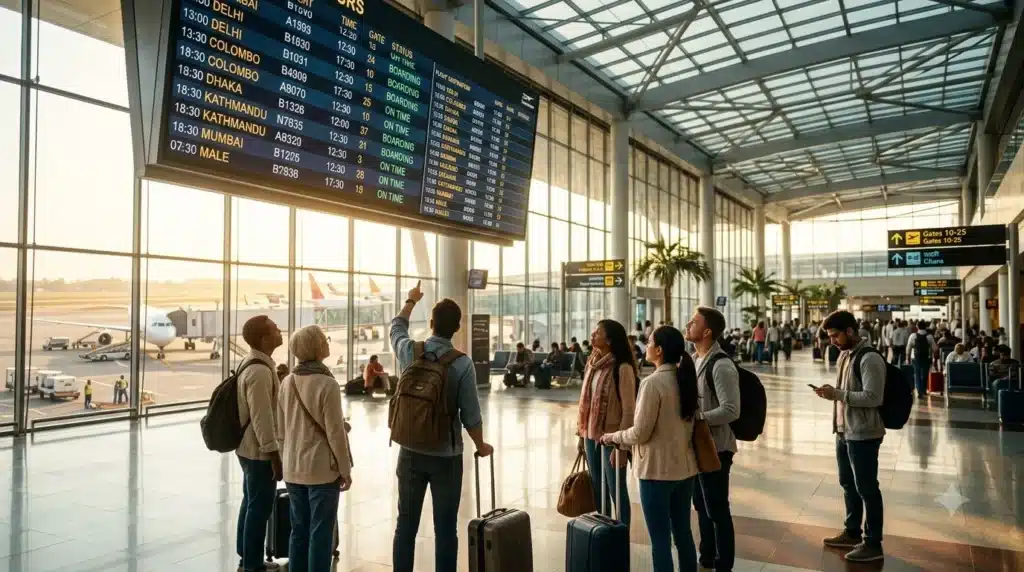
You land in Delhi, spend a week in Rajasthan, then fly to Colombo for the beaches. Easy, right? It would be in Europe. In South Asia, the same plan can cost you a missed connection, a surprise baggage bill, or a night on a terminal bench.
Cross border flights South Asia travelers book are rarely as seamless as the airline apps suggest. Neighboring countries have different visa rules, different baggage cultures, and airports that treat “transit” in very different ways.
This guide walks you through the real routes, the traps, and the paperwork, so your multi-stop trip runs the way you planned it.
Major Regional Air Corridors and Carriers
Start with where the planes actually go. Most routes in this region radiate out of a handful of hubs, and knowing which airline owns which corridor saves you hours of searching.
India to Sri Lanka
This is the busiest and easiest corridor in the region. Flights between India and Sri Lanka run daily from Delhi, Mumbai, Chennai, Bengaluru, Hyderabad and Kochi into Colombo (CMB). Chennai and Kochi are the shortest hops, usually around an hour and a half.
IndiGo and Air India cover most of these routes, and SriLankan Airlines flies many of them as well. SriLankan is the better pick if you want a through-ticket with onward connections, since it can check your bag all the way to your final stop.
India to Nepal and Bhutan
The flight from Delhi to Kathmandu (KTM) takes about two hours. Air India, IndiGo and Nepal Airlines all fly it, and Nepal Airlines is the national flag carrier. Expect weather delays in monsoon season, and be careful with tight connections out of Kathmandu.
Bhutan is a different story. Paro International (PBH) sits in a deep Himalayan valley, and only a small pool of certified pilots can land there. Drukair and Bhutan Airlines are the two carriers that operate it, with flights from Delhi, Kolkata and Bagdogra. Paro operates in daylight and clear weather only, so schedules shift often.
Bhutan also requires a pre-approved visa and a daily Sustainable Development Fee for most foreigners. Confirm the current rate on the official Tourism Council of Bhutan site before you book anything.
Island Routes to the Maldives
Male (MLE) connects directly to Delhi, Mumbai, Bengaluru, Chennai, Kochi and Trivandrum, plus Colombo. Several carriers serve these routes, including IndiGo, Air India and SriLankan.
Colombo to Male is a popular add-on for travelers combining Sri Lanka with a resort stay. Book it as part of a single itinerary when you can, because the flight is short and one delay can ripple through your hotel and transfer bookings.
The Hidden Traps of South Asian Aviation
Airlines will happily sell you a connection. They won’t always warn you about what can go wrong. These three traps catch the most travelers.
Baggage Allowance Discrepancies
Domestic and international weight limits are not the same, and the gap is wider than most people expect. Economy fares on Indian domestic flights often allow 15 kg of checked luggage, while international economy tickets commonly allow 20 to 30 kg depending on the carrier and fare.
The trap appears when your itinerary mixes both. A flight from Delhi to Jaipur followed by Jaipur to Colombo may force you to pay for excess weight on one leg. Cabin bags are also checked more strictly on domestic hops, often capped at 7 kg.
Check the allowance for every leg before you pack. Buy extra weight online in advance, because airport counter rates run much higher.
Separate Tickets vs. Through-Check Baggage
This is the costliest mistake in multi-stop planning. If you book connecting flights Kathmandu Colombo Delhi on separate tickets, each airline treats you as a brand-new passenger.
That means three things:
- Your bag will not transfer automatically. You collect it and re-check it.
- You must clear immigration and customs at the connecting airport, so you need a valid visa for that country.
- If your first flight runs late and you miss the second, the second airline owes you nothing.
A single ticket, or one issued under an airline partnership, protects you. If you must book separately, leave a buffer of at least five to six hours.
Terminal Changes
Delhi and Mumbai both have separate terminals for domestic and international flights. Moving between them means collecting bags, passing through immigration, and re-entering security.
At Delhi, IndiGo operates much of its domestic flying from Terminal 1, while most international flights, including Air India’s, use Terminal 3. Mumbai splits its domestic and international operations in a similar way. A shuttle bus connects the terminals, but the transfer can easily take 90 minutes or more once queues are included.
Always check the terminal on your boarding pass. Airlines shift terminals occasionally, so recheck 24 hours before departure.
Quick-Reference Hub Comparison Matrix
Rules change by nationality, so treat this as a planning guide and confirm with your airline before you fly.
| Hub Airport | Transit Visa Required? | Minimum Recommended Layover | Baggage Through-Check Availability |
| Delhi (DEL) | Usually no, if airside on one ticket. Yes if you clear immigration. | 3 hrs (one ticket); 5-6 hrs (separate tickets) | Yes on one ticket; no on separate tickets |
| Mumbai (BOM) | Usually no, if airside on one ticket. Yes if you change terminals. | 3-4 hrs (one ticket); 6 hrs (separate tickets) | Yes on one ticket; domestic-to-international often needs re-check |
| Colombo (CMB) | Usually no for airside transit. Entry needs a visa or ETA. | 2.5-3 hrs | Yes on SriLankan and partner tickets |
| Kathmandu (KTM) | Treat it as an entry point. Visa on arrival for most. | 3-4 hrs | Limited. Depends on the airline |
Visa and Cross-Border Entry Rules
Here’s the rule that trips up more travelers than any other: if your route passes through India twice, you need a visa that allows it.
India’s 30-day e-tourist visa is double-entry. The one-year and five-year versions are multiple-entry. Flying Delhi to Colombo and back to Delhi uses both entries on the shorter visa, with nothing left for a third pass. Plan your route first, then choose your visa.
Keep these basics in your bag:
- A printed copy of every e-visa. Phones die and Wi-Fi fails at immigration.
- Proof of onward travel, since many countries ask for it at check-in and again at arrival.
- Hotel confirmations for each stop.
- A passport with at least six months of validity and two blank pages.
Other countries have their own steps. Sri Lanka requires an online travel authorization for most nationalities. Nepal issues visas on arrival at Kathmandu for a fee, payable in US dollars at the counter. The Maldives gives a free 30-day tourist visa on arrival, but it also requires an online traveler declaration shortly before you fly. Verify each government’s current rules a few weeks before departure.
Plan Your Multi-Stop South Asia Trip with Samisha Holidays
Planning a South Asia loop is easier when the flights, visas and hotels are handled together. If Sri Lanka is on your list, start with our Sri Lanka tour packages and read The Spice & Serenity Route to see how a Southern India and Sri Lanka combination works day by day. Want a beach break after the trip? Our fixed-departure Bali tour package is a popular next step, and the visa-free and e-visa destinations guide helps you choose where to go after that. If you’d rather not build the route yourself, our custom tour planning team will stitch together flights, transfers and on-call support for a multi-stop itinerary. You can also browse our group departures, cruise holidays and Women’s Special tours for ready-made options from Pune.
Frequently Asked Questions
Do foreigners need a visa to transit through Delhi?
Often no, if you stay airside and connect on a single ticket in the same terminal. You need an Indian visa the moment you clear immigration, for example to switch terminals or collect bags. Rules vary by nationality, so confirm with your airline.
Can I transit through South Asian airports without a visa?
In most cases, yes, when you remain in the international transit area and hold a through-ticket. Colombo and Delhi both allow airside transit for most nationalities. Separate tickets usually force you through immigration, which means you need an entry visa.
What are the luggage rules on cross-border flights in South Asia?
Allowances depend on the fare and the airline. Domestic economy often allows 15 kg checked baggage and 7 kg in the cabin. International economy typically allows 20 to 30 kg. Buy extra weight online ahead of time, as airport rates are higher.
Which budget airlines fly between South Asian countries?
IndiGo, Air India Express and SpiceJet connect India with Sri Lanka, Nepal and the Maldives on many routes. Sri Lanka’s FitsAir flies regional routes too. Budget fares usually exclude checked baggage and meals, so compare the full cost before booking.
Samisha Holidays LLP, Pune, plans multi-stop South Asia itineraries end to end, from flights and visas to hotels and transfers. Visit samishaholidays.in to start planning.