
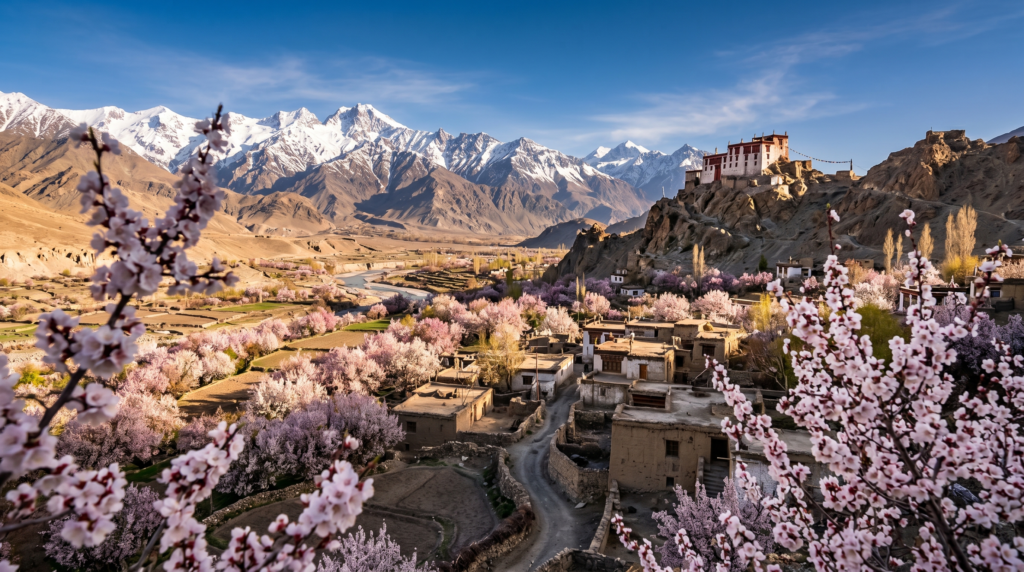
Every March, Apricot Blossom in Ladakh turns one of the world’s harshest high-altitude deserts into something that stops you mid-breath. I’ve stood in Hundar village at dawn, snow still sitting on the Karakoram peaks above, watching entire valleys erupt in soft pink and white — and honestly, no photograph I’ve ever taken has come close to doing it justice.
This isn’t cherry blossom season in Japan. No curated parks, no tourist infrastructure around every corner. Just raw mountain villages, ancient monasteries, and apricot trees doing their quiet, extraordinary thing.
What Is Apricot Blossom — And Why Does It Matter?
Locally called Chulli Mendok, this annual bloom signals far more than a pretty photo opportunity. For Ladakhi farming families, the apricot tree is life itself — food, income, and a marker of seasons changing after a long, brutal winter.
The bloom typically starts in late March and runs through mid-April. Early April hits peak — that’s when entire hillsides go pink simultaneously, and the contrast against brown rocky terrain and snow-capped ridges is genuinely surreal.
The Apricot Blossom Festival
The Apricot Blossom Festival is a week-long community celebration tied to this bloom period. Villages across the Sham and Nubra valleys host cultural programmes — traditional music, folk dances, handicraft exhibitions, and local food stalls selling apricot-based everything.
If you ask me, this festival is one of the most genuine cultural experiences left in North India. No mass tourism packaging. Just locals celebrating what their land does every spring.
Best Time to Visit for Apricot Blossom in Ladakh
Timing is everything — and it shifts each year slightly depending on snowfall patterns and temperature. Go too early, and you’ll catch bare branches. Too late, and the petals are already gone.
Late March to mid-April is your safe window. The first two weeks of April usually deliver peak bloom across most valleys. Check local updates before booking — Ladakhi guesthouses and social media groups dedicated to Leh travel post real-time blossom reports every season.
Must-Try Things to Do in Ladakh During Blossom Season
Walk the Sham Valley Blossom Trail
The Sham Valley Blossom Trail is the single best thing you can do during this season. Often called the “Apricot Blossom Valley” by local guides, Sham runs along the Indus River west of Leh — villages like Nimmu, Basgo, and Likir sit here, each surrounded by orchards that go completely wild with pink in April.
Walk between villages rather than driving. Stop when a local waves you over — they usually will. Shared cups of butter tea happen more than once if you’re open to it.
Visit the Sangam
The confluence of the Indus and Zanskar rivers — just outside Leh — carries a visual drama that pairs perfectly with spring light. Blue-green Zanskar meets the murkier Indus in a sharp colour divide. Go in the morning when the light is low and golden.
Try Every Apricot Thing
Apricot jam on local bread for breakfast. Apricot juice cold from a roadside stall. Dried apricots bought directly from a village family — they’ll pour them into a newspaper cone and hand it over for almost nothing.
The fresh apricot desserts served during the festival season are worth planning your meals around. Don’t skip them.
Explore Local Craft Markets
Handmade items carved from apricot wood — bowls, prayer beads, small frames — show up at village markets during this period. Embroidered textiles, pashmina scarves, and traditional Ladakhi jewellery round out what’s on offer.
Buy directly from artisans where possible. Bargaining is fine; aggressive haggling isn’t the local style here.
Recommended 5-Day Itinerary
Day 1 — Arrival in Leh: Rest First, Everything Else Second
Land at Kushok Bakula Rimpochhe Airport and do almost nothing for the rest of the day. I mean that literally. Leh sits at 3,500 metres. Your body needs time.
Check into your guesthouse, eat a light meal, and drink plenty of water. Shanti Stupa is a gentle first evening walk if you feel up to it — views over the city are stunning at sunset, and the altitude gain is gradual.
Day 2 — The Sham Valley Blossom Trail
This day is the heart of the trip. Leave Leh early, ideally by 7 am, and drive west along the Indus toward Nimmu village — roughly 35 kilometres out.
From Nimmu, walk the trail through Basgo and toward Likir. Apricot orchards line the path on both sides. Ancient rock carvings appear on boulders beside the trail. Stop at Basgo Monastery — it perches above the valley with painted murals inside that date back centuries.
Locals here often invite passing travellers in for tea. Accept every invitation.
Day 3 — Domkhar Valley and the Quiet Villages
Domkhar Valley sits east of Leh along the Indus and receives far fewer visitors than Sham Valley — which is exactly the point. Small mud-brick villages here are surrounded by apricot orchards just as spectacular as anything in the more famous areas.
Spend the day walking slowly between villages, photographing old gompas, and sitting beside the river. Truth be told, Day 3 in Domkhar was my personal favourite from my entire Ladakh trip — quieter, more personal, completely unhurried.
Day 4 — Nubra Valley via Khardung La
This one requires an Inner Line Permit — sort it out on Day 1 either online through the Leh District Permit Tracking System or via your guesthouse. Don’t skip this step.
Khardung La Pass at 5,359 metres is one of the highest motorable roads in the world. The drive itself is extraordinary — views from the top stretch back over Leh and forward into Nubra. Push through to Turtuk and Tyakshi villages in upper Nubra, where apricot trees bloom against a backdrop of peaks approaching 7,000 metres. Spend the night in Nubra.
Day 5 — Pangong Lake via Shyok Route and Return
The Shyok River road to Pangong Lake is newer and far more dramatic than the old Changla route. Salt flats, river crossings, and empty desert valleys give way eventually to that impossible blue expanse.
Pangong sits at 4,350 metres. Even in April, snow lines the far shore. Head back to Leh in the afternoon for departure prep.
Offbeat Places to Visit in Leh Ladakh During Blossom Season
Most blossom visitors stick to the obvious spots. But here’s the thing — some of the best experiences in Ladakh happen off the main circuit.
Uleytokpo is a riverside village with apricot orchards growing right to the water’s edge. Quiet, gorgeous, and almost always uncrowded during festival week.
Achinathang, along the Indus, pairs ancient rock art with dense apricot groves. The petroglyphs here are extraordinary — carved figures thousands of years old, sitting casually beside walking trails.
Dha and Hanu villages are home to the Brokpa community — a group whose cultural traditions and physical appearance differ distinctly from other Ladakhi communities. Visiting here requires an Inner Line Permit and genuine cultural sensitivity. Go slowly, ask before photographing, and understand that you’re a guest in someone’s living heritage.
Useful Information You Must Know Before You Go
Acclimatisation is non-negotiable. Altitude sickness is real. Rest on Day 1 without exceptions — headaches, nausea, and worse happen to fit travellers who push too hard, too fast.
Carry hard cash. ATMs in Leh exist but run out of notes frequently. Beyond Leh, digital payments often don’t work at all. Bring enough rupees to cover your entire trip comfortably.
Inner Line Permits are required for Nubra Valley, Pangong Lake, Khardung La, and Tso Moriri. Apply online or through local agents in Leh — the process is straightforward but needs a day’s lead time.
Book accommodation early. The April blossom season fills up fast. Hotels, guesthouses, and homestays all get booked weeks in advance. Don’t leave this until the last minute.
Dress respectfully at monasteries. Cover shoulders and legs. Remove shoes before entering prayer halls. Photography rules vary — always ask first.
App-based taxis don’t really exist here. Rent a bike if you’re comfortable at altitude, or book a local taxi driver for multi-day hire — many speak English and double as informal guides.
Plan Your Ladakh Trip With Expert Help
Witnessing Apricot Blossom in Ladakh is a once-in-a-lifetime experience — and getting your travel plan right makes all the difference. Before heading to Nimmu or Turtuk, browse our handpicked Leh Ladakh Tour Packages for fully planned itineraries that cover the blossom season perfectly. If you’re combining Ladakh with a Kashmir visit, our Jammu & Kashmir Tour Packages are worth exploring too. Heading to the hills before or after your Ladakh trip? Check out our Himachal Pradesh Tour Packages for seamless add-on options. For travellers who love offbeat Himalayan destinations, our Uttarakhand Tour Packages offer equally stunning spring experiences. Also, if international travel is on your radar after Ladakh, explore curated Bhutan Tour Packages and Nepal Tour Packages — both neighbouring Himalayan destinations that pair beautifully with an India mountain itinerary. For fully customised travel experiences built around your schedule and budget, visit Samisha Holidays LLP — our team specialises in tailor-made Himalayan journeys, luxury getaways, and group travel across India and beyond.
Final Word
Ladakh in April is a version of the place most people never see. The crowds of summer haven’t arrived yet. The roads are quiet. The apricot trees are doing something ancient and extraordinary — blooming at 3,500 metres against every logical expectation.
Go before everyone else figures this out.
F&Q
Q1. When exactly does Apricot Blossom season start in Ladakh?
Apricot Blossom in Ladakh typically begins in late March and runs through mid-April. The peak bloom — when orchards across Sham Valley, Nubra Valley, and Domkhar are in full pink and white flower — usually falls in the first two weeks of April. That said, exact timing shifts each year slightly based on winter snowfall and spring temperatures, so checking local updates before booking is always a smart move.
Q2. Do I need a permit to visit Ladakh during the Apricot Blossom Festival?
You don’t need a permit simply to enter Leh or attend the Chulli Mendok festival. However, an Inner Line Permit (ILP) is mandatory for visiting restricted areas, including Nubra Valley, Pangong Lake, Khardung La Pass, and Tso Moriri. You can apply online through the Leh District Permit Tracking System or arrange it through a local travel agent in Leh within a day.
Q3. Is Ladakh safe to visit in March and April for first-time travellers?
Yes — spring is actually one of the most rewarding times to visit Ladakh. The crowds of peak summer haven’t arrived yet, roads are generally accessible, and the weather during the day is pleasant. Nights remain cold, so carrying warm layers is essential. The one thing every first-timer must respect is acclimatisation — rest properly on your first day in Leh and avoid physical exertion for at least 24 hours after arrival.
Q4. Which villages offer the best Apricot Blossom views in Ladakh?
The Sham Valley Blossom Trail — covering villages like Nimmu, Basgo, and Likir — is the most popular and most rewarding route. Turtuk and Tyakshi in the Nubra Valley are equally spectacular. For offbeat places to visit in Leh Ladakh during blossom season, head to Uleytokpo, Achinathang, or the Domkhar Valley — far fewer tourists, just as much beauty.
Q5. How many days should I plan for a Ladakh trip during blossom season?
A minimum of 5 days is recommended to do the season justice. This gives you one full day for acclimatisation in Leh, two days covering the Sham Valley Blossom Trail and Domkhar Valley, one day for Nubra Valley, and a final day for Pangong Lake before departure. If your schedule allows 7 days, you can explore the offbeat Aryan Valley villages of Dha and Hanu — one of the most unique cultural experiences in all of Ladakh.