
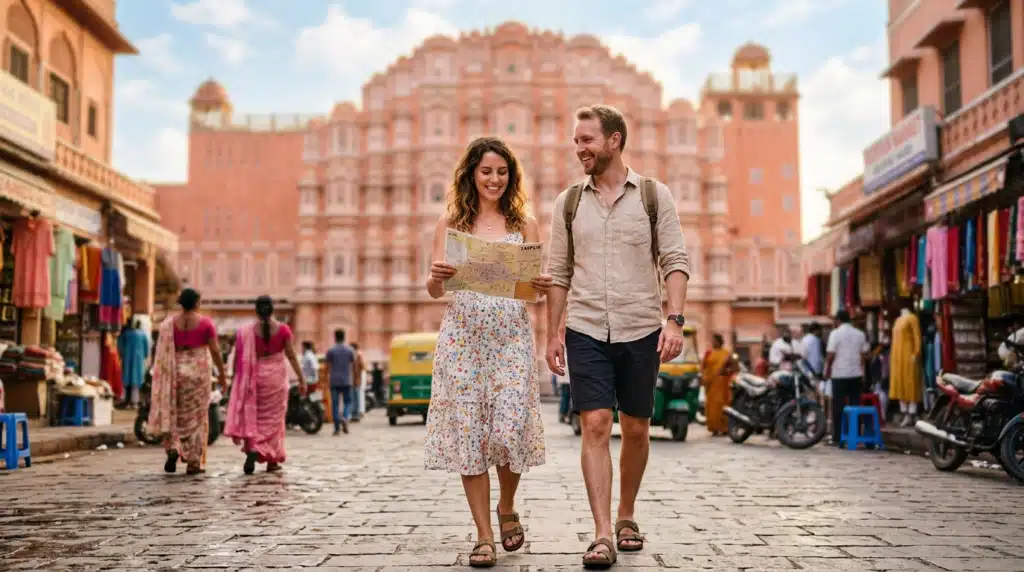
India is extraordinary. That part is true and consistent and doesn’t require qualification.
The Taj Mahal at sunrise. The Ganga Aarti in Varanasi. The amber-lit forts of Rajasthan. The spice-layered cuisine that puts every Western approximation to shame. The hospitality — the genuine, overwhelming, pressing-chai-into-your-hands hospitality — of people who treat foreign guests as an honour rather than a transaction.
But here’s what nobody tells you before your first trip.
Landing in Delhi or Mumbai for the first time is a full sensory assault that no travel documentary, Instagram account, or guidebook paragraph fully prepares you for. The noise. The scale. The immediate, persistent attention from taxi touts, unofficial guides, and “helpful” strangers whose helpfulness has a price point attached. The heat. The traffic operating on rules that appear entirely optional.
None of this makes India a bad destination. It makes it a destination that rewards preparation and punishes naivety.
This guide is the preparation. Twelve specific, avoidable mistakes that first-time travellers from the USA, UK, Europe, Australia, and Canada consistently make — and exactly how to avoid every one of them.
Samisha Holidays operates as an inbound Destination Management Company across India, Nepal, Bhutan, and Sri Lanka. We’ve watched every mistake on this list play out in real time. Consider this guide the briefing from a local friend who knows exactly what’s coming.
The First-Timer’s Smart Survival Matrix
| The Rookie Mistake | Why It Ruins Your Trip | The 2026 Smart Hack | How Samisha Holidays Bulletproofs It |
| Exchanging currency at the airport | Losing 10–12% to hidden spread margins | Pre-load a multi-currency forex card before departure | Forex card guidance included in pre-departure briefing |
| Eating street food without local curation | Risk of Delhi Belly from unverified vendors | Eat street food only at recommended, high-turnover stalls | Curated local food recommendations at every destination |
| Hailing unmetered taxis at arrivals | 3–5x overpricing; occasional safety risk | Book Uber/Ola from within the app before exiting terminal | Pre-arranged private airport transfers at every arrival |
| Cramming too many cities into 7 days | Exhaustion replaces enjoyment; nothing lands properly | One city per 2 days minimum; quality over quantity | Itinerary pacing built around experience depth, not checkbox coverage |
12 Critical Mistakes to Avoid in India
Mistake 1 — Applying Through Fraudulent Visa Portals
This is where trips end before they begin. Search “India visa apply” and the first several results include convincing lookalike websites that charge USD 50 to USD 150 to “process” applications on your behalf — then deliver nothing, or worse, steal your passport information.
The only legitimate portal for entry requirements for India 2026 is indianvisaonline.gov.in — the official Government of India e-Visa system. Bookmark it directly. Apply there. Pay the government fee, which is significantly lower than any third-party site charges.
The e-Tourist Visa processes in 72 to 96 hours. Print two copies of the approval. Carry both throughout India. Done.
Mistake 2 — Packing the Wrong Wardrobe
India’s sacred sites — and there are hundreds of them across any standard itinerary — require covered shoulders and legs for entry. This applies to all genders, all temples, all mosques, all Sikh Gurdwaras, and most Jain sites.
Turning up at Varanasi’s ghats in shorts and a sleeveless top doesn’t make you culturally insensitive — it makes you a person who can’t enter the most interesting parts of the destination. Pack light, breathable fabrics that cover appropriately. Carry a scarf in your day bag at all times — the most practical single item in your India travel kit.
Flip-flops or easily removable shoes are essential. You will be removing footwear dozens of times across any India itinerary.
Mistake 3 — Accepting “Free” Airport Rides or Trusting Fake Information Booths
Both Delhi and Mumbai airports have well-documented scams operating immediately outside the arrivals hall.
Unofficial “helpers” approach with offers of free rides to your hotel — the ride is never free, and the destination is rarely the hotel you booked. Unofficial “Tourist Information Centres” inside and near terminals look official and aren’t — they book you into overpriced hotels on commission.
The legitimate pre-paid taxi counter is inside the terminal, clearly marked, and operates on fixed government rates. Uber and Ola both work from Indian airports — book from inside the terminal before you exit, confirm the vehicle details on the app, and walk past anyone offering assistance between the exit doors and your ride.
Samisha Holidays meets all guests at arrivals with a name board beyond the terminal exit — eliminating the arrivals hall gauntlet entirely.
Mistake 4 — Falling for the “This Monument Is Closed Today” Scam
This operates at the Taj Mahal, Red Fort, Amber Fort, and several Jaipur monuments without variation. A friendly English-speaking stranger approaches as you walk toward the monument entrance, expresses sympathy about the fact that the site is unfortunately closed today for a special ceremony, and offers to take you instead to their cousin’s handicraft shop where you can see similar craftsmanship.
The monument is never closed. The cousin’s shop is real. The markups are extraordinary.
Walk directly to the official entrance gate and verify opening status yourself. The monuments of India follow publicly available opening schedules and close only on specific national holidays. Any stranger who tells you otherwise before you’ve reached the gate is running the scam.
Mistake 5 — Drinking Tap Water or Using Raw Ice Cubes
Delhi Belly — the diplomatically named gastric disruption that affects a percentage of western visitors — is almost entirely preventable with one rule: nothing enters your mouth that came from an unverified water source.
Drink bottled water exclusively. Carry your own bottle and refill from hotel-provided sealed bottles or established water dispensers. At restaurants, ask specifically for no ice — ice in Indian restaurants is made from local water and represents one of the most common vectors for travellers’ gastric illness.
Brush your teeth with bottled water. This sounds extreme. It isn’t extreme. It’s the standard practice among India travel professionals.
Fruit that you peel yourself — mangoes, bananas, oranges — is generally safe. Pre-cut fruit from street stalls is not. Cooked food at busy, high-turnover restaurants with visible kitchen activity is generally safe. Food sitting in open containers at low-traffic stalls is not.
Mistake 6 — Overloading the Itinerary
This is the most common mistake made by intelligent, well-researched first-time India visitors. Delhi, Jaipur, Agra, Varanasi, Kerala, and Mumbai in eight days looks achievable on a map.
It isn’t. India’s distances, traffic, and transit times operate on different logic than western itinerary planning assumes. Delhi to Agra by car is 3.5 hours on a good day. Agra to Jaipur is 4 hours. Varanasi involves a flight connection. Kerala is a separate journey entirely.
Cramming this into eight days means spending half of every day in transit, arriving at hotels exhausted, and seeing every destination at a surface level that satisfies the checklist without delivering the experience.
Budget a minimum of two full days per city. Three is better. For first-time India visitors, a luxury Golden Triangle tour India — Delhi, Agra, Jaipur, done properly over eight to ten days — delivers far more value than six destinations rushed across the same period.
Mistake 7 — Getting Ripped Off at Airport Currency Exchange Booths
Airport exchange booths in India — as in most countries — apply spreads of 8 to 12 percent below interbank rates. On a USD 500 cash exchange, that difference costs USD 40 to USD 60 in invisible fees.
Pre-load a multi-currency forex card in Indian Rupees before departure — available from BookMyForex, Thomas Cook, or most major Indian banks’ international divisions. Use it at Indian ATMs where needed, and exchange minimal cash at the airport only for immediate taxi and porter costs on arrival.
Additionally, carry some USD cash for emergencies — USD is accepted by most upscale properties and tour operators as an alternative to INR when digital payment isn’t available.
Mistake 8 — Not Buying a Local Postpaid SIM Card on Landing
An Indian phone number changes the entire trip. Uber and Ola both require local number registration for the Indian market version of their apps. WhatsApp-based communication with local guides, restaurants, and operators all assumes an active local number. Hotel check-in systems increasingly require local contact details.
Indian prepaid SIM cards have registration complications for foreign passport holders at certain retailers. The most reliable approach is purchasing a postpaid tourist SIM through an established retailer at the airport or in the first city — Airtel’s tourist SIM is the most widely recommended for international visitors. Samisha Holidays guides every guest through this process on arrival day.
Mistake 9 — Assuming All Street Food Is Either Safe or Dangerous
The truth is more nuanced than either extreme. Indian street food at its best — the right stalls, the right cities, the right dishes — is among the most extraordinary eating available anywhere on earth. Avoiding it entirely out of caution means missing one of India’s defining experiences.
The curation matters. High-turnover stalls — ones with queues of local customers, visible fresh cooking, and rapid ingredient rotation — are significantly safer than low-traffic stalls where food sits. Fried and freshly cooked items are safer than pre-prepared wet items. Large cities’ established street food zones — Delhi’s Chandni Chowk, Jaipur’s Johari Bazaar lane, Mumbai’s Chowpatty Beach — have operated under public health awareness for years.
Samisha Holidays provides specific street food recommendations at every destination — the exact stalls, the exact dishes, and the exact neighbourhoods where the experience is extraordinary and the risk is minimal.
Mistake 10 — Attempting to Drive Solo on Indian Roads
Do not do this. Not in Delhi. Not in Jaipur. Not anywhere in India on your first visit.
Indian road navigation operates on a logic system that takes years of local immersion to understand. Lane markings are suggestions. Horn usage is constant and carries specific communicative meanings that aren’t immediately obvious. Traffic merging, roundabout priority, and pedestrian crossing conventions all differ significantly from Western equivalents.
International driving licences are legally valid in India. The reality of driving in Indian city traffic as a first-time visitor is a different matter entirely from the legal permission to do so.
Private luxury tours of India with professional drivers are not an indulgence — they are the single most practical decision you make for your entire India trip. Your driver knows the roads, knows the shortcuts, knows where to park near monuments, and knows how to communicate with local toll and permit systems. You see India through the window rather than through a steering wheel and a stress response.
Mistake 11 — Forgetting to Pre-Book Monument Entry Tickets
The Taj Mahal fast-track entry system means pre-purchased tickets allow direct access to the monument’s entry gate, bypassing the general ticket queue that regularly runs 45 to 90 minutes on peak days.
Amber Fort, Qutub Minar, Red Fort, and several Jaipur monuments all have similar online pre-booking systems. All of them move faster for pre-booked visitors. None of them close without notice.
Samisha Holidays purchases all monument entry tickets as standard inclusions within every itinerary — guests arrive at gates, skip queues, and enter. The ticket coordination that adds 30 to 90 minutes to independent visitor experiences adds zero minutes to managed ones.
Mistake 12 — Booking via Offshore Western Travel Aggregators
This is the final and most expensive mistake — paying a London or New York agency a 30 to 40 percent retail markup for services they’ve subcontracted to an Indian DMC who handles the actual delivery.
The hotels, drivers, guides, and monument tickets in your Western agency package were sourced from an Indian ground operator — at wholesale rates — and resold to you at retail. Booking directly with the best inbound tour operator in India — the DMC that was always going to execute your trip — removes that markup and puts the savings back into your travel budget or your accommodation upgrade.
The Golden Triangle and Beyond — Executing a Flawless Luxury India Tour
A properly managed luxury Golden Triangle tour India demonstrates exactly what the right local operator delivers.
Private AC vehicle available from 7 am to 9 pm daily — not a shared transfer that picks up other passengers after you. A certified English-speaking guide at every monument who decodes history rather than reads a printed card. Pre-purchased monument tickets at every site. Restaurant recommendations that balance authentic experience with hygiene verification. A 24/7 WhatsApp concierge who answers questions about where to buy genuine pashmina versus tourist-grade copies, what the fair price for a rickshaw should be, and whether the pharmacy you’ve found is legitimate.
The transformation this produces — from anxious western tourist navigating India defensively to confident traveller actually engaging with the country — is the difference between surviving India and experiencing it.
From Indian Palaces to Himalayan Peaks: Our Extended Subcontinent Blueprints
India is the beginning of a much larger South Asian travel story. For the complete subcontinent arc, our Ultimate South Asia Panorama: 21-Day Itinerary extends through Nepal, Bhutan, and Sri Lanka. The full cross-border logistics blueprint is covered in our Multi-Country South Asia Blueprint: India, Nepal, and Bhutan. Bhutan’s specific permit and fee structure is explained completely in our Bhutan Travel Guide for Foreigners: SDF and Visas. First-time India visitors should read our Traveling to India from USA/UK: A Complete Guide for the full entry requirements picture. For a spiritually combined North India and Nepal circuit, our Perfect 14-Day Northern India and Nepal Spiritual Tour Package sequences Varanasi and Kathmandu into a single journey. Travellers considering extending into Sri Lanka should start with our honest Is Sri Lanka Safe for International Travelers? assessment, and our How to Combine India and Sri Lanka for the Ultimate Vacation details the full dual-country routing.
India Shouldn’t Be Survived — It Should Be Celebrated
Every mistake on this list is avoidable. Every scam is predictable. Every logistical complication has a straightforward solution that locals apply as second nature.
The gap between a stressful India trip and a transformative one isn’t the destination — it’s the preparation and the local support around you when you arrive.
With a trusted inbound tour operator in India managing your private transport, curating your restaurants, pre-booking your monument tickets, and answering your WhatsApp messages within minutes rather than business days, India stops being something to navigate defensively. It becomes what it actually is — one of the most extraordinary countries on earth, opening itself to visitors who arrive prepared to receive it properly.
Upload your rough itinerary draft or share your travel dates with Samisha Holidays today. Our team will build a secure, customised, and completely stress-free private luxury tour of India blueprint for your 2026 visit — at no charge, with no obligation, and with the full benefit of every lesson this guide has covered built into every single day of your programme.
India is waiting. Let’s make sure you’re ready for it.