
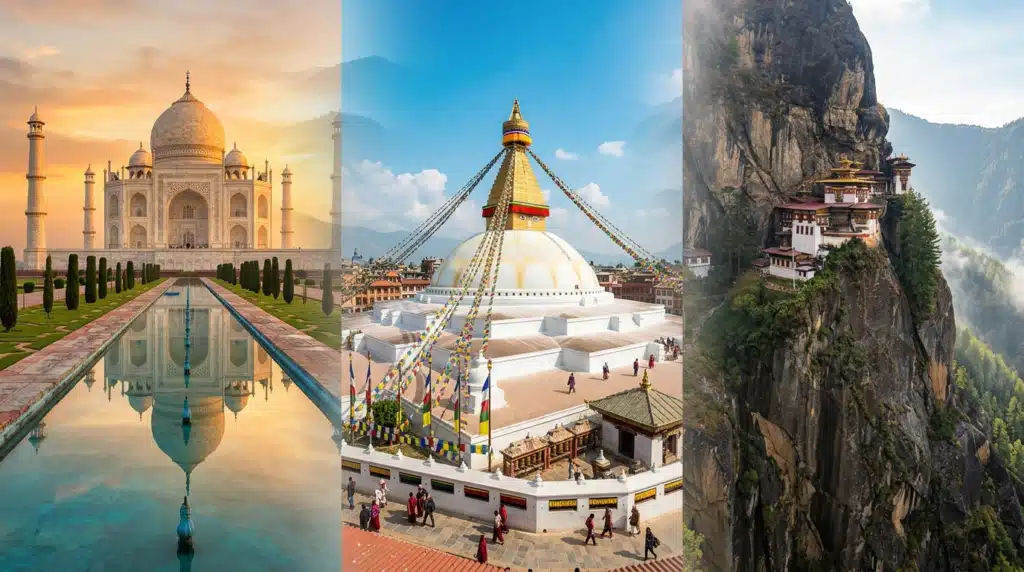
Three countries. Three completely distinct civilisations. One journey that most travellers spend years planning and then abandoning because the logistics look impossible from the outside.
They aren’t.
India Nepal Bhutan tour packages are among the most logistically complex journeys available in South Asia — and among the most consistently rewarding when the planning is handled by people who execute this circuit as routine professional practice. The regal heritage of India’s Mughal palaces. The sacred mountain valleys of Nepal’s ancient Buddhist kingdoms. The carbon-negative fortress kingdoms of Bhutan, where tourism is controlled by design and the result is one of the most pristine travel environments on earth.
The friction points that collapse independent planning attempts are specific and consistent. Three separate visa systems operating on different documentation and timing requirements. Drukair and Bhutan Airlines flight schedules into Paro that fill months in advance on limited weekly frequencies. Mountain weather patterns that require contingency planning built into the itinerary rather than bolted on after disruption occurs. Bhutan’s legally mandatory licensed operator requirement that most first-time visitors discover only after attempting to book independently.
Samisha Holidays operates as a regional Destination Management Company across all three countries — handling every visa, every regional flight, every cross-border transfer, and every permit under a single unified booking. This guide explains exactly how the multi-country South Asia travel circuit works, and what flawless execution of it actually looks like.
Triple-Nation Border and Flight Routing Matrix
| Flight Leg / Sector | Primary Carrier | Avg. Flight Time | Visa / Permit Action | Samisha Ground Handling |
| Delhi (DEL) → Kathmandu (KTM) | Air India, IndiGo, Himalaya Airlines | 1 hour 20 minutes | Nepal Visa on Arrival at KTM; USD cash required | Pre-arrival briefing; KTM representative at arrivals |
| Varanasi (VNS) → Kathmandu (KTM) | Buddha Air, IndiGo | 55 minutes | Same Nepal VoA process | Preferred routing over Delhi for itinerary efficiency |
| Kathmandu (KTM) → Paro (PBH) | Drukair, Bhutan Airlines | 1 hour 20 minutes | TCB permit + SDF pre-arranged; Visa Clearance Letter mandatory | Drukair seat allocation secured months in advance |
| Paro (PBH) → Delhi (DEL | Drukair via KTM connection | 3 to 4 hours total | Exit permit confirmed by licensed operator | Paro ground team manages departure documentation |
Stage 1: The Cultural Engine — Crafting the Perfect India Foundation
Why Delhi Is the Right Starting Point
Every best South Asia multi-country tour package we design begins in New Delhi. Logistically, Delhi functions as South Asia’s primary international aviation hub — direct connections from London, New York, Sydney, Toronto, and every major European city land at Indira Gandhi International with consistent scheduling and reliable onward connections.
Culturally, Delhi is the right opening statement. Three thousand years of continuous civilisation compressed into a city that somehow operates simultaneously in the medieval and the modern. Humayun’s Tomb’s Mughal geometry. The Red Fort’s imperial sandstone. Old Delhi’s Chandni Chowk at breakfast — jalebi and chai from a corner halwai whose family has occupied the same spot for four generations.
The Golden Triangle — Agra and Jaipur
Two days in Delhi, then the private car south to Agra. The Taj Mahal at sunrise remains the single most described building on earth — and description still falls short. Arrive at the East Gate before 6 am. Stand at the central axis as the marble shifts from silver through rose to blinding white. Accept that photographs won’t capture it and stay longer than you planned.
Jaipur closes the Golden Triangle loop — Amber Fort’s Sheesh Mahal, City Palace’s layered royal architecture, and the bazaars of Johari and Bapu where block-printed textiles and gemstones compete for attention across every shopfront.
Varanasi — The Perfect Launch Pad Into Nepal
The India leg ends in Varanasi — strategically, not just spiritually.
Varanasi sits geographically positioned for the most efficient flight transition into Nepal. The Varanasi to Kathmandu route runs under an hour on Buddha Air and IndiGo — eliminating the backtrack to Delhi that many South Asia itineraries build in unnecessarily.
Spiritually, the transition from the Ganges ghats to the Buddhist stupas of Kathmandu creates the specific narrative arc that makes this three-country journey feel like a continuous story rather than three separate trips assembled into a sequence.
The Ganga Aarti ceremony at Dashashwamedh Ghat — brass lamps, chanting priests, and thousands of devotees pressed to the riverside steps — is the India finale that the Nepal transition follows naturally. Samisha Holidays arranges a privately chartered river boat for the ceremony viewing, positioned mid-stream with unobstructed panoramic sightlines and live classical sitar performance.
Stage 2: The Alpine Transition — Discovering Nepal’s Sacred Valleys
Landing in Kathmandu
The Nepal Visa on Arrival at Tribhuvan International Airport is available to citizens of India, USA, UK, Europe, Australia, and Canada — USD cash in exact denominations speeds the process considerably. Samisha Holidays provides a complete pre-arrival briefing covering exact fee amounts, form requirements, and the specific immigration lane that processes VoA holders most efficiently.
Our Kathmandu representative meets guests in the arrivals hall — name board confirmed, vehicle waiting — and manages the transfer to the first Kathmandu property without any navigation uncertainty on the guest’s part.
The Kathmandu UNESCO Heritage Circuit
Boudhanath Stupa anchors the Kathmandu experience. The mandala-shaped structure — among the world’s largest Buddhist stupas — sits at the centre of a community of Tibetan monasteries and prayer wheel corridors that have operated continuously for centuries. The morning kora (circumambulation walk) at 6:30 am, with monks, elderly devotees, and occasional pilgrims from Tibet sharing the circuit, is among the most genuinely meditative experiences available to any traveller in Nepal.
Swayambhunath on its hilltop above the city — 365 steps to the summit, painted Buddha eyes watching the valley — provides the first Himalayan range sighting of the journey on clear mornings. The northern horizon shows the Langtang and Ganesh Himal ranges through the Kathmandu valley’s rim.
Patan Durbar Square — a medieval royal plaza whose 17th-century temples survived the 2015 earthquake in better condition than Kathmandu’s equivalent — is managed by a specialist architectural guide Samisha Holidays assigns for every guest. The iconographic programme of these temples requires explanation to be properly understood; without it, the square remains visually impressive but culturally opaque.
Pokhara — The Lake and the Mountains
The domestic flight from Kathmandu to Pokhara takes 25 minutes and runs along the Annapurna range at close enough range that Dhaulagiri, Annapurna I, and Machhapuchhre are distinguishable through the cabin window.
Mountain weather management is where local operator expertise becomes operationally critical. Pokhara’s mountain flights are weather-dependent — cloud build-up by midday makes morning departures significantly more reliable for clear visibility. Samisha Holidays books all Nepal domestic flights on the earliest available slot and maintains direct contact with airline operations teams for real-time weather updates that affect departure timing.
Phewa Lake at dawn — the Annapurna range reflected in still water before the morning breeze disturbs the surface — is the Pokhara image that most travellers consider their Nepal highlight. A wooden rowboat on the lake costs almost nothing and delivers a quality of visual experience that no organised boat tour replicates.
Stage 3: The Mystical Finale — Stepping Into Bhutan’s Locked Kingdoms
The Kathmandu to Paro Flight — The Journey’s Defining Moment
The Kathmandu to Paro flight on Drukair or Bhutan Airlines is, by any honest assessment, among the most extraordinary scheduled commercial flights operating anywhere in the world.
On clear mornings — which the early departure slots Samisha Holidays books are specifically designed to capture — Everest, Kangchenjunga, Lhotse, and the full eastern Himalayan spine are visible from the aircraft window as the plane traverses Nepal’s mountain landscape. The Paro approach then descends through a narrow Himalayan valley at low altitude, with mountain ridges appearing at cabin window level before the runway materialises below.
Book Drukair seats as early as possible. This is not standard travel advice inflated into urgency. Paro Airport handles a genuinely limited weekly flight schedule — Drukair and Bhutan Airlines between them operate a small number of weekly services to Paro from Kathmandu. Peak October and April season availability disappears months before departure. Samisha Holidays holds contracted seat allocations on these services for confirmed package guests.
Bhutan’s Entry Requirements — The Legal Mandatory Operator Rule
Bhutan cannot be visited independently. This is not a policy preference or a safety recommendation — it is a legal requirement of the Tourism Council of Bhutan. All international tourists must book through a licensed Bhutanese tour operator or an internationally accredited partner DMC. Independent travel, self-guided touring, and unaffiliated accommodation bookings are not permitted within the kingdom.
The Sustainable Development Fee — currently USD 100 per person per night for international tourists — is paid through the licensed operator and contributes directly to Bhutan’s free healthcare, free education, and environmental conservation infrastructure. This is the mechanism by which Bhutan maintains its extraordinary conservation record and its deliberately low tourist volume.
Samisha Holidays holds full Tourism Council of Bhutan accreditation. The TCB permit application, SDF payment, and Visa Clearance Letter issuance all happen within our standard booking process — guests receive their clearance documentation well before departure and board their Drukair flight with every requirement confirmed.
Thimphu, Punakha, and the Tiger’s Nest
Buddha Dordenma above Thimphu — a 51-metre golden statue overlooking the entire capital valley — establishes Bhutan’s architectural and spiritual register on the first afternoon.
Dochula Pass at 3,150 metres on the Thimphu-Punakha drive — 108 memorial chortens arranged across a hilltop with the full Himalayan range visible behind them on clear mornings — is the landscape moment that most Bhutan travellers photograph first and remember longest.
Punakha Dzong, built at the confluence of the Pho Chhu and Mo Chhu rivers in 1637, is the most architecturally refined building in Bhutan. Its whitewashed towers rise directly from the river — the approach across the cantilever bridge delivers the building in stages that build anticipation properly.
Tiger’s Nest — Paro Taktsang — closes the Bhutan journey. The two-hour hike through blue pine forest to the viewpoint across the gorge, then the final descent and ascent to the monastery entrance, accumulates into the defining physical and spiritual experience of the entire three-country journey.
No description of the monastery — pressed impossibly into a 900-metre cliff face, white buildings and golden rooftops catching the morning light — carries the actual weight of standing in front of it for the first time. That moment is unrepeatable. Every other travel experience in this itinerary builds toward it.
White-Glove Coordination — How Samisha Holidays Synchronises Your Journey
Flight Allocation and Fare Protection
Drukair and Bhutan Airlines operate limited weekly services into Paro — seat availability is genuinely constrained and fills seasonally months in advance. Samisha Holidays maintains bulk-contracted seat allocations on these services, protecting confirmed package guests from the erratic fare surges that affect open-market bookings as departure approaches.
Across India’s domestic network, Nepal’s mountain airline services, and Bhutan’s international routes, every flight in this itinerary is booked as a single coordinated sequence — baggage allowance variations between regional carriers are documented and communicated to guests before departure, eliminating the excess fee surprises that catch independent travellers at regional check-in counters.
Specialist Local Guides at Every Border
Each country in this itinerary has its own guide and driver — a specialist in their specific national heritage, language, and cultural context rather than a generalist accompanying the group across all three borders.
The Delhi and Agra guide holds formal training in Mughal architectural history. The Varanasi guide is a specialist in Hindu ritual practice and ghat geography. The Kathmandu guide has studied Newar Buddhist temple iconography. The Bhutan guide is a licensed TCB-certified guide with deep knowledge of Dzongkha culture and Himalayan Buddhist tradition.
Consequently, every destination on this itinerary is explained by someone for whom it is home — not someone reading from the same research document the guest has already consulted.
24/7 Central Operations Support
A dedicated Samisha Holidays operations contact remains available across all three countries throughout the itinerary — same number, always answered, in the same time zone as wherever the disruption occurs.
Mountain weather cancellations in Nepal. Road closures in Bhutan. Medical situations at altitude. All managed in real time by our ground team rather than escalated through an overseas intermediary sleeping in a different time zone.
This is the operational difference between booking with a regional DMC and booking with a Western aggregator who subcontracts to local operators. The chain of responsibility is shorter by two links — and in an emergency, those two links matter completely.
Tailor Your Himalayan and Subcontinent Journey
This three-country blueprint is one configuration within a broader South Asian portfolio. For the complete four-country arc including Sri Lanka, our Ultimate South Asia Panorama: 21-Day Itinerary extends the journey to its natural conclusion. First-time India visitors should start with our Traveling to India from USA/UK: A Complete Guide before finalising any subcontinent routing. The earlier version of this cross-border planning guide — our How to Plan a Seamless Multi-Country Tour to India, Nepal, and Bhutan — covers the operational mechanics in complementary detail. Travellers wanting to deepen their India experience with private cultural access should read Beyond the Taj Mahal: 10 Culturally Immersive Luxury Experiences before finalising the India leg itinerary. And the complete Bhutan entry requirements, SDF breakdown, and permit process are covered with full transparency in our Bhutan Travel Guide for Foreigners: SDF and Visas Explained.
Commission Your India Nepal Bhutan Journey With Samisha Holidays
A multi-country South Asia tour is, for most travellers who complete it, the journey they measure everything else against. Three civilisations. Three distinct spiritual traditions. Three completely different relationships between architecture and landscape. All connected within a single itinerary that — when managed correctly — feels not like three trips compressed into one, but like a single continuous narrative that happens to cross borders.
It shouldn’t be spent monitoring Drukair availability calendars, calculating SDF payments, or refreshing TCB permit status pages. Those logistics belong in our operations system — not your holiday experience.
Fill out our comprehensive custom subcontinent inquiry form today to arrange a private virtual consultation with a senior travel architect at Samisha Holidays. Together, we’ll lock in your seamless India Nepal Bhutan tour package — exact routing, confirmed flight allocations, heritage hotel selections, and a transparent cost breakdown — in a single focused conversation.
The three jewels of the subcontinent are waiting. Let’s connect them properly.