
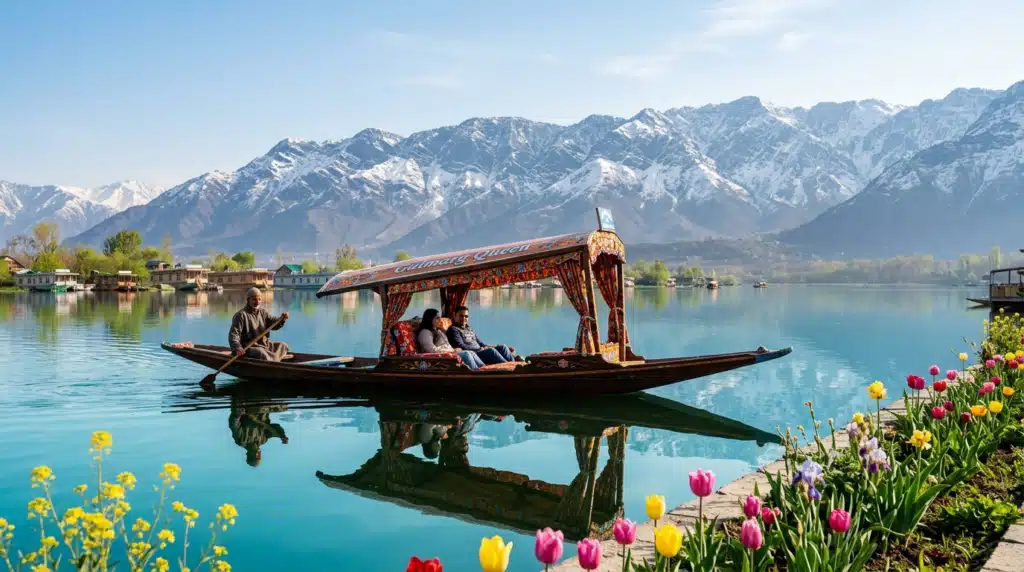
Kashmir arrives differently for every traveller. For some it’s the first sight of Dal Lake — that flat, impossible blue surface with the Zabarwan mountains reflected perfectly in it. For others it’s the smell of chinar wood smoke in a Pahalgam morning. For families from Pune who’ve spent a decade talking about going, it’s the moment the Srinagar flight descends through clouds, and the valley opens below — green and dramatic and exactly as beautiful as they’d been told.
The Pune to Kashmir itinerary is one of the most rewarding domestic journeys available from Maharashtra. And it’s one of the most logistically detailed — flight connections, seasonal timing, houseboat selection, valley taxi regulations, mobile network restrictions, and Gondola booking windows all require attention that first-time Kashmir travellers rarely anticipate.
Samisha Holidays has managed Kashmir tours for Pune families, honeymoon couples, and senior citizen groups across every season. This guide covers the complete planning picture — from Pune Airport departure routing to Gulmarg Gondola pre-booking — so that the trip itself is pure experience rather than operational anxiety.
Kashmir Seasonal Travel Matrix — 2026
| Travel Season | Ideal Dates 2026 | Landscape and Climate | Core Highlight | Samisha Booking Advice |
| Spring — Tulip Festival | Late March to mid-April | Blooming orchards, 10–18°C, some rain | Asia’s largest tulip garden, Dal Lake at its most vivid | Book by January; April houseboat allocations fill by February |
| Summer — Green Meadows | May to June | Lush green valleys, 20–28°C days, cool nights | Gulmarg meadows, Sonmarg glacier, Pahalgam rivers | Best family season; book 45–60 days ahead |
| Autumn — Chinar Season | September to November | Golden chinar leaves, 10–20°C, clear skies | Mughal gardens in autumn colour, apple harvest | October is peak; book by August for confirmed stays |
| Winter — Snow and Skiing | December to February | Heavy snowfall, −5 to 10°C, dramatic landscapes | Gulmarg skiing, frozen Dal Lake, snow-covered houseboats | Book Gondola tickets 45+ days out; heating-confirmed hotels essential |
The Definitive 6 Nights 7 Days Pune to Kashmir Itinerary
Day 1 — Arriving in Srinagar and Living on a Luxury Houseboat
The Kashmir tour package from Pune begins at Pune Airport — direct flights to Srinagar (SXR) operate via Delhi on Air India, IndiGo, and Vistara. Total journey time with the Delhi connection runs approximately 4 to 5 hours. Early morning Pune departures connect efficiently to late morning Srinagar arrivals, leaving the full afternoon for settling in.
Samisha Holidays assigns a private sanitised vehicle with a vetted local driver at Srinagar Airport — no negotiating at the taxi stand, no confusion over routes.
The houseboat experience begins on Day 1 afternoon. Samisha Holidays pre-selects from a curated list of Category A and Category Deluxe houseboats on Dal Lake and Nigeen Lake — carved walnut wood interiors, heated rooms, attached bathrooms, and a dedicated houseboat staff who manage meals and Shikara bookings on behalf of guests.
Nigeen Lake houseboats are the choice for honeymooners and guests wanting quieter water than the more trafficked Dal Lake stretches. Dal Lake’s proximity to the main Boulevard and floating vegetable market is the better choice for families who want activity and access.
Evening Shikara ride at sunset is non-negotiable on Day 1. The light on Dal Lake between 5 pm and 7 pm — golden, long, and reflecting off the Zabarwan range behind the city — is the image most Kashmir visitors carry home as their defining memory. Your houseboat staff arranges the Shikara directly; Samisha Holidays confirms this as a standard Day 1 inclusion for all packages.
Day 2 — Mughal Gardens and Old Srinagar
Day 2 covers Srinagar’s classical itinerary at an unhurried pace.
Shalimar Bagh opens the morning — a 17th-century terraced Mughal garden designed by Emperor Jahangir for his queen Nur Jahan, with four terraced levels rising above a central water channel lined with chinar trees. In October, the chinar canopy turns gold and deep red simultaneously, making Shalimar Bagh’s autumn version one of the most visually extraordinary gardens in India.
Nishat Bagh sits 2 kilometres further along the Dal Lake shore — twelve terraces climbing the Zabarwan hillside, each with its own water feature. The uppermost terrace looks back across the entire lake to the city and mountains beyond.
Chashme Shahi — the smallest but oldest of the royal gardens — holds a natural spring that has been channelled through the garden since the Mughal period. The water is genuinely drinkable and cold.
For April travellers, the Indira Gandhi Memorial Tulip Garden on the Zabarwan slopes above Dal Lake is the undisputed priority — Asia’s largest tulip garden with over 1.5 million blooms in 60+ varieties. Visit on a weekday morning to avoid the peak weekend crowd.
Old Srinagar’s Nowhatta quarter covers the afternoon — the old city’s wooden architecture, the Shah-i-Hamdan mosque facade, and the traditional craft shops selling papier-mâché boxes, crewel embroidery, and Kashmiri silverware at prices that airport and Boulevard shops can’t approach.
Wazwan dinner at a traditional Kashmiri restaurant — the multi-course royal feast of rogan josh, gushtaba, tabak maaz, and yakhni — should be experienced at least once during the Srinagar stay. Samisha Holidays recommends specific restaurants based on group dietary requirements.
Day 3 — Srinagar to Sonmarg: The Meadow of Gold
The Sonmarg day excursion covers 84 kilometres from Srinagar along the Sindh river valley — a drive that becomes progressively more dramatic as the road climbs above the treeline and the Sindh runs increasingly blue and fast alongside.
Sonmarg translates literally as Meadow of Gold — named for the yellow wildflowers that cover the alpine meadow in summer. The snow-covered Thajiwas Glacier sits 3 kilometres from the main meadow, accessible on foot or by pony — the pony ride through the meadow to the glacier base is a specific Kashmir experience that children respond to enthusiastically.
Zero Point at the top of the Zoji La approach road — accessible during summer months when the road is clear — offers snow exposure at 11,500 feet without the trekking commitment of higher altitude destinations.
Return to Srinagar by 6 pm for dinner and houseboat overnight.
Day 4 — Srinagar to Pahalgam: The Valley of Shepherds
The drive from Srinagar to Pahalgam covers 95 kilometres through the Kashmir Valley floor — passing Pampore’s saffron fields (purple-flowering in October-November, the most vivid saffron growing region in the world) and the Avantipur ruins (9th-century Hindu temple complex beside the Jhelum river, UNESCO-listed and largely unknown to casual tourists).
Pahalgam arrives as the Lidder River road narrows into a valley with pine forest closing in on both sides. The town sits at 2,130 metres — noticeably cooler than Srinagar, with the specific pine-and-river smell that makes Pahalgam’s air immediately distinctive.
Check into a luxury riverside resort — Samisha Holidays pre-selects Pahalgam properties with Lidder River-facing rooms, as the sound of the river through an open window is a specific sensory experience worth requesting explicitly.
Evening Lidder river walk along the main promenade — local shepherds bring their flocks back through the valley in late afternoon, producing a pastoral scene that feels entirely removed from 21st-century India.
Day 5 — Secret Valleys of Pahalgam: Aru, Betaab, and Chandanwari
This is the practical logistics day — and Samisha Holidays manages it entirely.
Pahalgam’s inner valleys — Aru, Betaab, and Chandanwari — are accessible only through the local union taxi system. Private vehicles from Srinagar are not permitted beyond specific checkpoints. Samisha Holidays pre-coordinates the union vehicle booking from our Pahalgam ground partner, eliminating the negotiation and waiting that independent travellers face at the union taxi stand every morning.
Betaab Valley — named for the 1983 Bollywood film shot here — is a wide, flat meadow surrounded by pine-covered ridges with the Lidder River running through the centre. The meadow is genuinely beautiful and accessible for all fitness levels.
Aru Valley sits 12 kilometres further — a high-altitude pastoral valley with Himalayan backdrop views that most Pahalgam day-trippers miss because they turn back at Betaab.
Chandanwari at 2,895 metres is the starting point for the Amarnath Yatra pilgrimage route — accessible in a morning excursion with excellent snow and glacier views.
Evening pashmina shopping in Pahalgam’s main market is better value than Srinagar’s Boulevard shops — authentic Grade A pashmina shawls from verified local weavers, walnut wood craft boxes, and dried fruits from Kashmir’s orchard belt.
Day 6 — Ascending to Gulmarg: The Gondola and the Snow
The drive from Pahalgam to Gulmarg routes back through Srinagar and then 51 kilometres to the Gulmarg meadow at 2,650 metres — total driving time approximately 3 to 3.5 hours.
Gulmarg in winter is a fully operating ski resort. In summer, the same slopes carry wildflowers so dense that the gradient disappears under colour. In spring and autumn, a combination of both produces the specific visual quality that Gulmarg’s photography is known for.
The Gulmarg Gondola — Asia’s highest cable car — operates in two phases. Phase 1 climbs from Gulmarg town to Kongdoori at 3,080 metres. Phase 2 continues to Apharwat Peak at 3,980 metres — where the views extend across the entire Pir Panjal range and into Pakistan-administered territory on the northern horizon.
Book Gondola tickets 45 days in advance. This is not optional advice. The Gulmarg Gondola operates a daily quota system — walk-up tickets at the base station regularly sell out before 10 am during peak season. Black-market ticket reselling exists and is well-documented. Samisha Holidays books Gondola slots as a standard package inclusion, with Phase 1 and Phase 2 tickets confirmed before departure from Pune.
Overnight in Gulmarg at a centrally-heated luxury resort — the temperature at 2,650 metres drops significantly after sunset regardless of season, making heated rooms a non-negotiable requirement rather than a preference.
Day 7 — Farewell and Return Flight to Pune
Morning at leisure in Gulmarg — a final meadow walk, breakfast with valley views, and the specific Kashmir clarity that arrives on cold mornings when the air is completely still.
Drive to Srinagar Airport — approximately 1.5 hours. Your Samisha Holidays driver collects from the Gulmarg resort at the confirmed time and manages the airport transfer directly. The Srinagar to Delhi to Pune routing arrives back in Pune by late afternoon or evening depending on connection timing.
The itinerary ends. The adjustment to Pune’s pace takes a few days.
Essential Travel Tips for Pune Travellers Heading to Kashmir
Mobile Network Reality
Prepaid SIM cards do not work in Jammu and Kashmir — this applies to all networks including Jio, Airtel, and Vi prepaid connections without exception. Activate national roaming on your existing postpaid connection before departure, or purchase a local postpaid SIM at Srinagar Airport on arrival. BSNL postpaid provides the most reliable connectivity across all Kashmir Valley destinations including Sonmarg, Pahalgam, and Gulmarg.
Gondola Booking — The 45-Day Rule
Book Gulmarg Gondola tickets a minimum of 45 days before your Gulmarg day. The online booking portal (jktourism.org or the Gulmarg Development Authority portal) opens quota approximately 60 days before the travel date. Samisha Holidays monitors this for all confirmed Kashmir package guests and handles the booking as a standard service.
Packing by Season
Winter visitors (December to February): Thermal underlayers, heavy wool sweaters, waterproof outer jackets, insulated boots, and gloves are all mandatory — not optional comfort items. Gulmarg in January reaches −15°C at night.
Spring visitors (March to April): Light wool sweaters for mornings and evenings, a waterproof layer for afternoon showers, comfortable walking shoes for garden and meadow visits.
Summer visitors (May to June): Light cotton for Srinagar days, a medium fleece or jacket for Pahalgam and Gulmarg evenings, and waterproof layers for Sonmarg’s unpredictable afternoon weather.
Autumn visitors (September to November): Medium layering — cool mornings, pleasant afternoons, cold nights. A good quality shawl (buy one on Day 5 in Pahalgam) serves multiple functions.
From Snow-Capped Peaks to Global Horizons — Our Curated Travel Portfolios
Kashmir is the starting point for many Samisha Holidays travellers who develop a serious Himalayan travel appetite. For the complete subcontinent arc, our Ultimate South Asia Panorama: 21-Day Itinerary extends into Nepal, Bhutan, and Sri Lanka from an India base. Cross-border Himalayan planning is covered in our How to Plan a Seamless Multi-Country Tour to India, Nepal, and Bhutan, and Bhutan’s permit specifics are detailed in our Bhutan Travel Guide for Foreigners: SDF and Visas. International visitors should read our Traveling to India from USA/UK: A Complete Guide before finalising any India itinerary. For a spiritually combined North India circuit, our Perfect 14-Day Northern India and Nepal Spiritual Tour Package pairs Kashmir’s energy beautifully with Varanasi and Kathmandu. Festive season travellers should explore our Where to Celebrate Diwali 2026: Family Packages from Pune. For international travel starting from PNQ, our Direct Flights from Pune: Best International Destinations and Pune to Thailand Flight and Tour Guide cover the outbound options. Maharashtra weekend travellers should bookmark our Top 10 Monsoon Getaways Near Pune, 5 Hidden Waterfalls Near Pune, and Top 5 Beach Destinations in Konkan for a Family Trip.
Book Your Kashmir Tour Package From Pune With Samisha Holidays
Kashmir should not be spent arguing with union taxi dispatchers, waiting in Gondola queues that move in hourly increments, or lying under a damp houseboat blanket because heating wasn’t confirmed before booking.
It should be spent on a Shikara at sunset. Walking Betaab Valley at 9 am when the light is perfect,t and the crowds haven’t arrived. Standing at Apharwat Peak looking at the Pir Panjal range without a single operational worry in your mind.
Samisha Holidays makes that version available. Pre-confirmed Gondola tickets. Vetted local drivers who know Kashmir’s roads and valley access rules. Handpicked houseboats with genuine heating and genuine service. A dedicated itinerary architect who has built this specific journey dozens of times across every season.
Fill out our quick holiday inquiry form today or click our direct WhatsApp chat widget to receive a complimentary, customised 2026 Pune to Kashmir itinerary map from our dedicated Himalayan travel team.
Heaven on Earth is waiting. It just needs the right plan to get there properly.