
If you’ve been trying to figure out the best time to visit Kashmir in 2026, the honest answer is — it depends entirely on what kind of Kashmir you want to experience.
And here’s the thing — Kashmir is genuinely extraordinary in every single season. Snow-buried in January. Explosively colourful in April. Pleasantly cool in July when the rest of India is melting. Golden and quietly magical in October. No other destination in India delivers four such completely different versions of itself across a calendar year.
At Samishaholidaysllp, we send travellers to Kashmir year-round. This guide covers every season with the practical accuracy that only comes from repeated, on-ground experience.
Best Time to Visit Kashmir 2026 — Full Seasonal Breakdown
Winter in Kashmir — January to March
The Snow Season Nobody Regrets
Kashmir snowfall season 2026 peaks between late December and mid-February — and if fresh snow, frozen lakes, and ski slopes are what you’re after, this is your window.
Gulmarg transforms completely in winter. The ski resort here operates Asia’s highest cable car — the Gulmarg Gondola — lifting skiers and snowboarders to Apharwat Peak at 3,980 metres. Powder conditions between January and early March are world-class by any standard. Honestly, Gulmarg’s winter skiing is criminally underrated internationally.
Sonamarg in January is a different experience — quieter, more remote, and deeply beautiful. The valley fills with snow to a depth that buries ground-floor windows of local homes. Sledding, snowmobile rides, and frozen waterfall treks keep the itinerary full.
Pack seriously for this season. Temperatures in Gulmarg drop to minus 10 to minus 15 degrees Celsius at night. The traditional Kashmiri Pheran — a long woollen cloak worn over clothing — is genuinely practical, not just photogenic. Pick one up at Srinagar’s Lal Chowk market on arrival.
The Kangri — a small clay pot filled with burning charcoal carried under the Pheran for warmth — is something locals offer visitors freely. Accept it. It works better than most modern heated gear.
Road connectivity to Sonamarg can be disrupted during heavy snowfall. Samishaholidaysllp monitors conditions in real time and adjusts itineraries accordingly — this is one of the practical advantages of booking through an experienced Kashmir specialist.
Spring in Kashmir — April to May
Tulips, Orchards, and the Valley at Its Most Alive
Spring is the best month to visit Kashmir for first-timers — and the Srinagar Tulip Garden is the headline reason.
Asia’s largest tulip garden sits on the slopes of the Zabarwan Hills above Dal Lake. The 2026 Tulip Festival typically opens in late March and runs through mid-April, depending on bloom progression — exact dates are announced by the J&K Tourism Department closer to the season. Based on recent years, the first two weeks of April deliver peak bloom across all terraces.
Over 1.5 million tulips in 60-plus varieties cover the hillside in bands of red, purple, yellow, orange, and white — with Dal Lake and the Zabarwan range framing the background. Go on a weekday morning. Weekends get crowded quickly.
Pahalgam in spring is equally extraordinary. Apple and cherry orchards across the Lidder valley bloom simultaneously — the Betaab Valley and Aru Valley walks in April pass through a soft blur of white and pink blossoms against the still-snowcapped Pir Panjal range.
Temperatures in April range from 8 to 18 degrees Celsius — comfortable walking weather with light layers. May warms up further, making houseboat stays on Dal Lake genuinely pleasant by evening.
Summer in Kashmir — June to August
Cool Escapes and the Amarnath Season
Summer is peak tourist season in Kashmir — and for good reason. When the Indian plains are sitting at 40-plus degrees, Srinagar is a comfortable 28 to 30 degrees Celsius during the day.
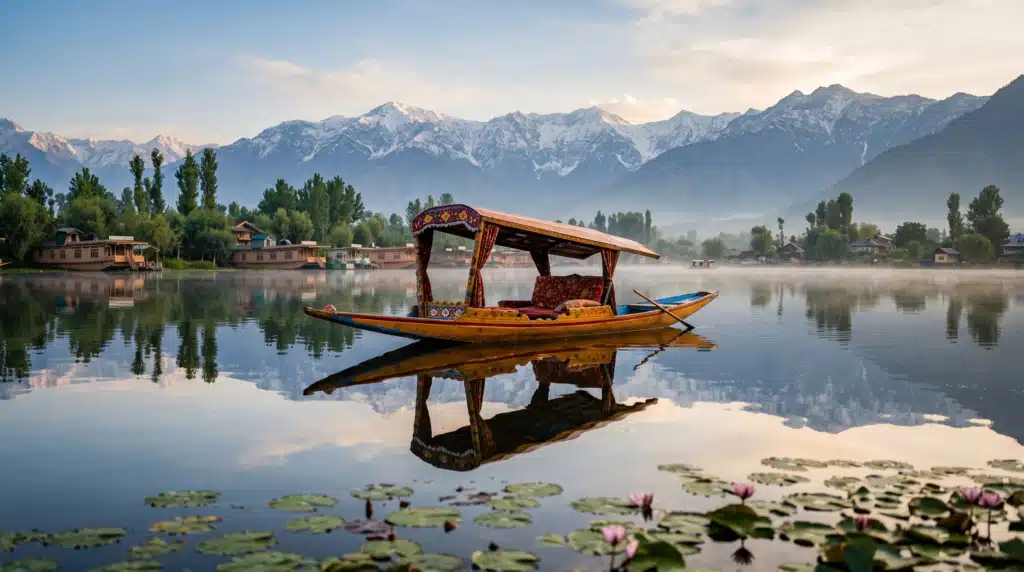
Dal Lake houseboat stays are best experienced in June and July. Traditional cedar wood houseboats — some over a century old — offer a unique accommodation experience that combines heritage architecture with front-row views of the Himalayas from a floating bedroom window.
The Shikara ride at dawn across Dal Lake is one of Kashmir’s defining experiences — flower sellers, vegetable boats, and kingfishers sharing the same misty water as the light comes up. Budget at least two mornings for it. One is never enough.
The Amarnath Yatra runs between July and August, drawing hundreds of thousands of pilgrims to the Amarnath Cave shrine in the Himalayan highlands above Pahalgam and Sonamarg. This creates significant traffic on certain mountain roads — Samishaholidaysllp itineraries during this period are routed specifically to avoid Yatra congestion while keeping access to Pahalgam and Sonamarg intact.
Gulmarg in summer is a completely different proposition from winter — green meadows, wildflowers, and pony rides replace the ski slopes. The Gondola still operates, delivering views across the Himalayan snowfields from a grassy summer summit.
Autumn in Kashmir — September to November
The Season Most Travellers Overlook — And Shouldn’t
If you ask me, September through October is the most underrated window in the entire Kashmir travel calendar.
The Chinar trees — Kashmir’s iconic broad-leafed plane trees — turn gold, amber, and deep red across the valley through October and into November. Srinagar’s Shalimar Bagh and Nishat Bagh Mughal gardens, already beautiful in summer, become genuinely spectacular when the Chinars frame them in autumn colour.
Apple picking season runs through September and October across Shopian and Sopore districts — the orchards are accessible, the fruit is exceptional, and buying directly from farmers costs a fraction of what the same apples cost in Pune markets.
October temperatures sit between 10 and 20 degrees Celsius — ideal trekking weather. The Kashmir Great Lakes trek — a 7-day high-altitude trail passing through six alpine lakes above Sonamarg — is best completed in September before early snowfall closes the higher passes.
November brings the first winter chills and the first dusting of snow on the higher ridges. Early winter light across the valley is extraordinary — sharp, golden, and long at dusk. Crowds have thinned considerably by mid-November.
Critical Local Information Every Kashmir Traveller Needs
Prepaid SIM cards do not work in Jammu & Kashmir. This is a long-standing security regulation and applies to all networks, including Jio, Airtel, and Vi prepaid connections. Postpaid connections from Airtel and Jio work reliably across Srinagar, Pahalgam, and Gulmarg. Activate postpaid roaming on your existing number before departing Pune, or purchase a local postpaid SIM in Srinagar on arrival.
Carry physical cash. ATMs exist in Srinagar but run out of notes during peak season. Beyond Srinagar, digital payments are unreliable. Pahalgam and Gulmarg operate significantly on cash — carry sufficient rupees for the entire trip.
Local union taxis are mandatory in Pahalgam and Gulmarg. Private vehicles — including Samishaholidaysllp hired cars — are not permitted beyond certain entry points in both hill stations. Local union taxis cover inner areas at fixed government rates. Our team briefs every guest on exact handover points to avoid confusion at checkpoints.
Respect local customs. Kashmir is a Muslim-majority region — dress modestly when visiting markets and mosques, avoid public alcohol consumption outside hotel premises, and be genuinely respectful during prayer times. Kashmiri hospitality is extraordinary — it responds in kind to genuine respect.
Kashmir Tour Packages With Samishaholidaysllp
Every Kashmir tour package from Samishaholidaysllp is built around the season you’re travelling in — not a generic template that ignores whether it’s tulip season or snowfall season.
Our Kashmir packages cover Srinagar houseboat stays, Gulmarg day excursions, Pahalgam valley drives, Sonamarg day trips, Mughal garden visits, and Shikara rides — all paced to feel immersive rather than rushed.
Flights from Pune connect to Srinagar (SXR) via Delhi or Mumbai — the total journey time runs 5 to 7 hours, including the connection. Samishaholidaysllp coordinates all flight options, hotel bookings, local transport, and postpaid SIM guidance within a single package conversation.
Things to do in Kashmir span every interest — skiing, trekking, cultural history, photography, food, and genuine mountain leisure. The valley accommodates all of them across all four seasons.
Reach out to the Samishaholidaysllp team to check current 2026 availability, festival dates, and package pricing for your preferred travel window.
F&Q
Q1. Is Kashmir safe for family trips in 2026?
Yes — Kashmir has been welcoming family tourists in large numbers consistently through recent years, and 2026 is expected to continue that trend. Srinagar, Pahalgam, Gulmarg, and Sonamarg all have well-established tourist infrastructure catering specifically to families. Samishaholidaysllp monitors ground conditions in real time and maintains direct contact with local partners — any itinerary adjustment needed for safety or access reasons is communicated immediately to guests.
Q2. Which month has the heaviest snowfall in Kashmir?
January and February consistently deliver the heaviest snowfall across Kashmir — particularly in Gulmarg, where snow depth can reach 10 to 15 feet at higher elevations during peak winter. Sonamarg and the Zoji La Pass area also see significant snowfall through February. For travellers specifically chasing the Kashmir snowfall season 2026, the last week of January through mid-February is historically the most reliable window for deep, photogenic snow conditions.
Q3. How many days are enough for a Kashmir trip?
A minimum of 5 nights and 6 days covers Srinagar including Dal Lake and Mughal gardens, Gulmarg for a full day, and Pahalgam with Betaab and Aru valleys comfortably. For travellers wanting to add Sonamarg, the Kashmir Great Lakes trek, or a Doodhpathri excursion, 7 to 8 days is the right window. Samishaholidaysllp recommends against itineraries shorter than 5 nights — Kashmir rewards slow travel and punishes rushing.
Q4. Do postpaid SIM cards from Pune work in Kashmir?
Postpaid connections on Airtel and Jio work reliably across Srinagar, Pahalgam, and Gulmarg. Prepaid SIM cards — regardless of network — do not function in Jammu & Kashmir due to regulatory requirements. Activate national roaming on your existing postpaid connection before departure from Pune. Connectivity in remote areas like Sonamarg upper meadows and Gurez Valley remains limited, regardless of the network. Inform family accordingly before heading to remote zones.
Q5. Is vegetarian food easily available in Kashmir?
Yes — vegetarian food is widely available across Kashmir’s tourist circuit. Wazwan — the traditional Kashmiri multi-course meal — is meat-heavy, but most Srinagar restaurants and hotels serve comprehensive vegetarian menus including dal, paneer dishes, Kashmiri pulao, and fresh breads. Pahalgam and Gulmarg both have restaurants catering specifically to vegetarian Indian tourists. Kashmiri bakeries producing the traditional Kandur bread and local honey with walnuts are naturally vegetarian and worth building into every morning’s breakfast.