
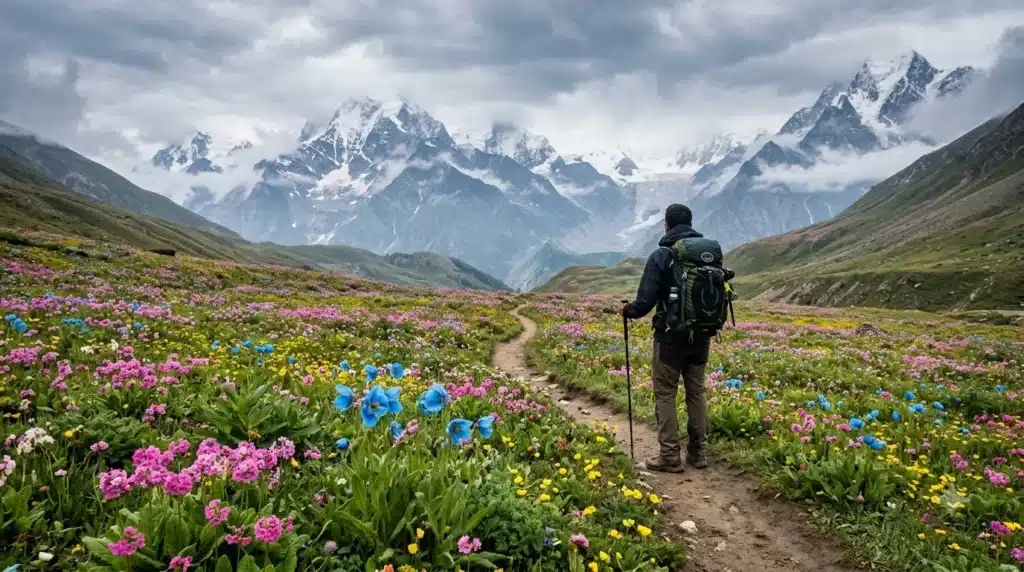
For eight months of the year, Bhyundar Valley is a frozen, silent basin high in the Garhwal Himalayas, buried under snow and completely off limits. Then, for roughly ten weeks between July and September, something happens that has no real equivalent anywhere else on the subcontinent. Meltwater and monsoon rain wake up a seed bank that’s been dormant since the last bloom, and over 500 species of endemic wildflowers erupt across the valley floor in a density that genuinely looks unreal in photographs, let alone in person.
August sits at the exact center of that window. This is peak density month, when the rare blue poppy and the sacred Brahma Kamal are both fully open, when the valley reads less like a trail and more like a colour field stretching to the base of the surrounding peaks. Miss this window, and you’re looking at either bare rock and snow or a valley that’s already thinning out toward its September close.
Here’s the honest part most Pune professionals underestimate about this trip: it isn’t a weekend hack. It’s multiple flight sectors, a full day of mountain driving through active landslide-risk terrain, real altitude to respect, and porters or mules to arrange correctly. This is exactly where monsoon treks India-wide start to separate the trips people actually finish from the ones that end in a rushed, undertrained retreat. Samisha Holidays exists to close that gap. As a specialized adventure tour operator, we build flight-inclusive Valley of Flowers packages that bundle private luxury AC vehicles from Dehradun, handpicked certified mountain guides, premium base camp stays, and a genuine emergency helicopter evacuation backup, not a promise on a brochure.
The Valley of Flowers Quick-Fact Expedition Table
Before the day-by-day plan, here’s the trek reduced to the numbers that actually matter for planning:
| Trek Parameter | The Technical Reality / Data | Why It Matters in August | Samisha Holidays Premium Management |
| Maximum Altitude | Hemkund Sahib, roughly 4,300 m / 14,100 ft | Genuine AMS risk begins above 10,000 ft, regardless of fitness level | Certified guides monitor pace and symptoms, with oxygen and a medical kit carried throughout |
| Total Trekking Distance | Approximately 38 km round trip across the full circuit | Manageable across 5–6 days; risky if compressed into fewer | Itinerary built with acclimatization buffer days, never a forced single push |
| Base Camp Location | Govindghat (roadhead) to Ghangaria, roughly 3,050 m | Ghangaria is the last point with real infrastructure before the high alpine zone | Pre-verified, centrally heated lodging in Ghangaria, confirmed before you arrive |
| Physical Fitness Tier | Moderate to High | Monsoon mud and the steep Hemkund Sahib climb both demand real stamina | Pre-trek fitness briefing, plus a realistic go/no-go call before the Hemkund day |
The Ideal August Trekking Itinerary: Day by Day
Day 1: The High-Speed Gateway — Pune to Dehradun and On to Rishikesh
A genuine non-stop flight connects Pune to Dehradun’s Jolly Grant Airport, roughly 2 hours 20 minutes in the air. It doesn’t run daily, so Samisha builds your departure date around the four days a week it actually operates, rather than leaving you to discover that gap yourself. A private AC vehicle meets you at arrivals for the short run into Rishikesh, where a premium wellness resort on the Ganges gives your body its first, easiest acclimatization step before the mountains start in earnest.
Day 2: The Scenic Mountain Drive — Rishikesh to Govindghat via Panch Prayag
This is the day that separates trekkers from tourists. A winding, roughly nine-hour drive traces the Alaknanda and Bhagirathi rivers north, passing through Devprayag and Rudraprayag, two of the five sacred river confluences that give this stretch of road its name. The scenery does most of the work; the road itself demands a driver who’s done this route dozens of times, which is precisely why we don’t hand this leg to a generic cab. You’ll overnight at a pre-verified, sanitary riverside lodge in Govindghat, the roadhead for everything that follows.
Day 3: The Alpine Ascent — Govindghat to Ghangaria Base Camp
The trek proper begins here: roughly 14 km alongside the roaring Laxman Ganga river, through dense pine forest and past waterfalls that monsoon rain keeps running at full force. Mules, porters, and pre-arranged helicopter slots are all real options on this leg, and our adventure tours from Pune network handles the booking for whichever suits your group’s fitness and time budget. A centrally heated boutique hotel in Ghangaria, the last proper settlement before the high alpine zone, is where you’ll base for the next two days.
Day 4: Entering the Garden of Gods — The Valley of Flowers
An early start gets you through the forest department checkpoint before the day’s crowds. What follows is a full day inside a UNESCO World Heritage valley, walking trails flanked by high-altitude glaciers, hunting for the golden lily, white anemones, and the blue poppy at their peak density. Nothing about this day should be rushed; the valley rewards slow walking and a lot of stopping to actually look, not a checklist pace. You’ll return to Ghangaria for hot local meals and an early night, since day five is the hardest of the trip.
Day 5: The Spiritual High — Hemkund Sahib
Six kilometres, one way, gaining roughly 1,280 metres of elevation. This is the steepest sustained climb on the entire circuit, and it’s not optional to underestimate. The reward at the top is the world’s highest Sikh shrine, standing beside a crystalline glacial lake at 14,100 feet, ringed by the rare Brahma Kamal growing wild at the water’s edge. Darshan runs 8 AM to 2 PM only, and the descent back to Ghangaria needs to start on time, not whenever the view finally lets you leave.
Days 6–7: The Return Transit — Descending to Dehradun and Flying Home
Retrace the trek down to Govindghat, then a comfortable private drive back to Dehradun. From there, smooth domestic flights return you to Pune, tired in the specific, good way that only a genuinely earned trek produces, with a phone full of photographs no filter can improve on.
High-Altitude Monsoon Survival Masterclass
Acute Mountain Sickness isn’t a fitness problem. It’s an altitude problem, and it hits trained athletes and casual walkers with roughly equal indifference above 10,000 feet. The single biggest defense isn’t hydration or supplements; it’s pace. A gradual, unrushed ascent gives your body time to adjust its oxygen processing, which is exactly why our itinerary spreads the elevation gain across multiple days instead of compressing it. Staying well hydrated genuinely helps your body cope with the thinner air, but treat it as one supporting habit among several, not a guarantee against AMS on its own. Know the early symptoms — headache, nausea, unusual fatigue, disturbed sleep — and treat any of them as a signal to stop ascending, not push through.
Gear matters just as much as pace. High-ankle, waterproof trekking shoes with deep lug grips are non-negotiable on the Govindghat-to-Ghangaria stretch, where monsoon mud turns smooth stone genuinely treacherous. A proper breathable poncho beats a cheap plastic raincoat every time; the plastic traps sweat, and wet base layers at altitude are how a manageable trek turns into a cold-exposure problem. Trekking poles save your knees on the steep Hemkund descent, and a simple waterproof case for your phone or camera is worth packing before you think you’ll need it, not after the first downpour.
Samisha Holidays tracks real-time weather advisories from the Indian Meteorological Department across your entire trip, adjusting transit routes and trek timings proactively rather than reactively. Combined with certified guides carrying oxygen and a proper medical kit, and a pre-arranged helicopter evacuation option for genuine emergencies, this is the difference between a bucket-list trek and a trip your family should reasonably worry about.
From Himalayan Peaks to Tropical Rain Trails
A trek like this tends to reset what “adventure” means for the trips that follow. If the Himalayas have you thinking bigger, [The Ultimate South Asia Panorama: 21-Day Itinerary] and [How to Plan a Seamless Multi-Country Tour to India, Nepal, and Bhutan] scale the same instinct up considerably. Hosting family visiting from abroad this year? [First-Time Travel to India from USA/UK: 12 Mistakes to Avoid] is worth sending before they land. Planning further out on the calendar, [The Definitive Guide to the Best Time to Visit Kashmir in 2026] and [Where to Celebrate Diwali 2026: Family Packages] cover the next two big windows worth booking early. If a passport stamp appeals more than another Indian summit, [Pune to Thailand Flight & Tour Guide], [Direct Flights from Pune: Best International Destinations], and [No Visa Worries: Top Visa-Free and E-Visa Destinations] pick up right where this guide leaves off. And for the weekends when a full Himalayan trek isn’t realistic, [Rain Trails and Coffee Estates: Why You Need to Visit Coorg and Munnar This August], [Beyond the Beaches: Exploring Off-Season Goa in Monsoon], [From Lakes to Palaces: Magical Family Tour to Udaipur This August], [Top 10 Monsoon Getaways Near Pune for a 2-Day Road Trip], [5 Hidden Waterfalls Near Pune You Must Visit], and [Top 5 Beach Destinations in Konkan for a Family Trip] keep the same instinct alive a lot closer to home.
Book Your August Valley of Flowers Expedition
No other trek in India compresses this much reward into this narrow a window. Miss August, and you’re waiting another eleven months for the valley to do this again. This is precisely why monsoon treks India-wide deserve real planning, not a last-minute booking and a hope that the weather cooperates.
Ready to claim your window before peak bloom passes? Fill out our quick adventure inquiry form, or tap the WhatsApp chat widget on samishaholidays.in. Samisha Holidays will build a fully customized, flight-inclusive Valley of Flowers itinerary from scratch, with guides, permits, and emergency backup already handled, so the only thing left for you to train for is the trek itself.
FAQ
1. When does the Valley of Flowers open in 2026, and when’s peak bloom?
The park opens in early July (July 3, 2026, this season) and stays accessible through September, but peak flower density falls specifically in the mid-July to mid-August window. August is when the rare blue poppy and the Brahma Kamal are both fully open, making it the single best month for species diversity and photography.
2. Is the Valley of Flowers trek suitable for beginners?
Yes, with the right preparation. The main valley trail is well-maintained and manageable for a reasonably fit first-timer, but the optional Hemkund Sahib extension is a different story — a steep 6-km climb gaining over 1,280 metres, which demands real stamina regardless of trekking experience.
3. How many days does the full trek take, including Hemkund Sahib?
Budget 5 to 7 days for the complete circuit from Rishikesh: acclimatization time, the trek into Ghangaria, a full day in the Valley of Flowers, the Hemkund Sahib extension, and the return journey. Compressing it into fewer days is possible but genuinely raises AMS risk, since it cuts the gradual pacing that makes the altitude gain manageable.
4. Is Hemkund Sahib part of the Valley of Flowers trek, or a separate trip?
They’re two distinct treks sharing the same base camp. Both start from Ghangaria, but the Valley of Flowers trail leads into the flower-carpeted meadows, while Hemkund Sahib climbs in the opposite direction to a glacial lake and Sikh shrine at 14,100 feet. Most trekkers do both, one per day, rather than treating either as optional.
5. Is trekking during monsoon actually safe?
The trek itself is specifically timed for monsoon, since that’s what triggers the bloom, and the maintained trail from Govindghat to Ghangaria handles rain reasonably well with the right gear. The bigger monsoon risk sits on the road, particularly the Rishikesh-to-Govindghat drive, where landslide-prone stretches call for a driver who knows the route and a flexible schedule rather than a fixed one.